








In This Article
- Why congressional power alone cannot guarantee enforcement of laws when the executive branch refuses to cooperate
- How the 2026 midterm results changed the political landscape and what they reveal about the limits of billionaire-funded campaigns
- Why Democrats must simultaneously legislate, investigate, and prepare a comprehensive governing agenda for 2029
- The case for building on existing legislative work rather than starting from scratch every congressional session
- How the New Deal comparison illuminates the opportunity for a two-year legislative head start before a potential change of administration
Something did shift in November 2026. Not everything. Not by a great deal. But something real. The democratic gains in both chambers of Congress changed the balance of power in Washington and for the first time since Donald Trump came back to the White House there is a legislative body with the votes, the subpoena power and the institutional muscle to do more than just issue press releases. That's significant. It's only significant if the people who now have that power understand what it can and can't do and use the next two years accordingly.
Here's the uncomfortable truth that we need to state outright: winning a congressional majority does not mean you run the government. It means you run part of the government. The part that drafts legislation, that appropriates funds, that conducts investigations. The part that can hold hearings, that can compel testimony and that can create a public record.
That is significant power. It is not the power to enforce federal law. That apparatus belongs almost entirely to the executive branch. When the executive branch is in the hands of someone who treats the Constitution as a set of suggestions rather than a constraint, the gap between what is legally permissible and what actually gets done becomes the single most important fact in American politics.
So the question for the Democrats isn't just 'what can we do in Congress?' It's a more fundamental question: what if the next two years were spent not just opposing the administration but actually building a full governing programme, a programme that was complete, thought through, well prepared and properly debated? What if the first 100 days of the next administration could effectively start two years early?
The Constitutional Crisis That Nobody Wants to Say Out Loud
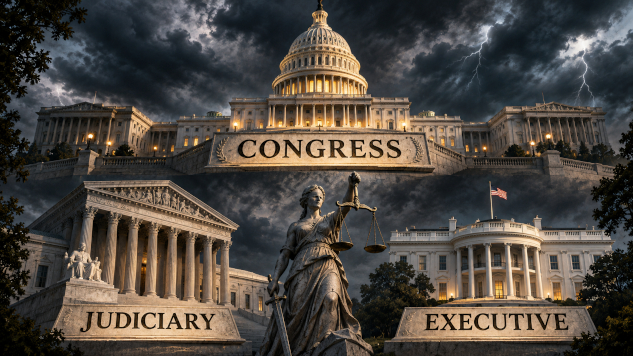
The American constitutional system is built on a very neat principle: three branches of government each with their own set of powers and each of them able to check the others. Congress makes the laws. The courts interpret the laws. The President implements the laws. That's the basic model that every schoolkid knows. What they don't learn is what happens when one of those branches simply refuses to do its job. That hasn't been tested very much in practice.
Congress has huge constitutional powers. It can pass legislation, control federal spending, conduct investigations, issue subpoenas, have people held in contempt and it can impeach the President or any other federal officer. The courts can issue binding judgments, injunctions and orders. These are not small powers. They are the very bedrock of constitutional government.
But think about the practicalities. Who actually enforces a congressional subpoena if the DOJ is in the position of refusing to prosecute contempt? Who ensures that court orders get obeyed if the executive agencies that are supposed to be carrying them out are slow to act, give them a different interpretation or just simply don't do anything? Who makes sure that funds which have been lawfully appropriated actually get to the people for whom they are intended if the Treasury Department is going to find some reason to delay?
The answer in most cases is the Executive Branch itself. The DOJ, the FBI, the U.S. Marshals Service, the Treasury payment systems through which so much of the federal government conducts business. All Executive Branch agencies. When they work as they should the system works. When they're being run by a President who treats the performance of constitutional duties as optional the system doesn't fall apart. It just deteriorates. Gradually, often invisibly, but inexorably.

This isn't a hypothetical scenario. We've seen it. Executive agencies have delayed compliance with court orders. Legally required payments have been withheld or threatened. Requests for information from Congress have been met with obstruction in the form of procedural objections. None of this required any formal statement that the Constitution had been suspended. It only required a willingness to go slow, to challenge every obligation and to dare the other branches to do something about it with the enforcement mechanisms which in the end depend on the Executive's co-operation.
Constitutional authority and the ability to actually enforce that authority are two very different things. To pretend they're the same is a luxury that the country can no longer afford.
Who Controls the Checkbook Controls Much of the Government
If you want to understand how power actually works in the Federal Government, follow the money. Not the campaign money (although that's important too). Follow the operational money. The money that pays for agencies to do their work, the money that keeps the courts open and the congressional staff paid.
Congress has the power of the purse. That phrase is so frequently used that it has lost some of its impact. What it actually means is that no federal funds can be spent without congressional authorization. The President cannot fund a program which Congress has not approved. That is real power. The catch is that Congress authorizes the spending and the executive agencies do most of the actual work of disbursing the funds.
Think about what that means in a confrontation. Congress appropriates funds for the federal courts, but the administrative systems that actually process the courts' pay go through the executive branch infrastructure. Congress funds its own operations but the wider financial architecture of the federal government is not something that Congress has built or has any direct control over. All federal employees, all government contractors, all Social Security recipients, all Medicare providers and all the veterans who receive benefits go through the executive branch system.
We've all seen what a government shutdown is like, with federal workers going without their pay and services effectively being shut down. There are all sorts of knock-on effects. Now imagine the even worse scenario of an administration making a deliberate, unlawful decision to withhold payments which are legally required as a form of leverage against the other branches of government.
A branch of government can be constitutionally independent while at the same time operationally vulnerable if its funding is cut off. That's not a hypothetical issue at all. It's a design flaw in a system which was predicated on all parties acting in good faith. When that good faith breaks down the ramifications are very real indeed. You see them in the form of missed paychecks, delayed benefits and institutions simply not being able to operate at the level required by the law.
Impeachment or the Ballot Box
So if Congress can't on its own get a recalcitrant executive branch to comply with the law, what are the options for changing executive leadership? There are two main constitutional mechanisms for democrats and both have serious limitations. Presidential resignation, succession after death, and the 25th Amendment also exist but are unlikely.
The first is impeachment. The House can impeach the President by a simple majority vote (that's just an accusation, akin to an indictment). Conviction and removal requires a two thirds vote of senators present. With the current Senate composition (Democrats having around 56 seats), that would require every single Democrat to vote for conviction and at least 11 Republicans to join them. Assuming all 100 are present.
Let that maths sink in. 11 Republican senators would have to vote to remove a president of their own party. In the current political climate where primary challenges and donor power have such a potent effect on party discipline that it's effectively absolute, that's a very high threshold. It's not impossible, it's just never happened in the actual removal of a president (Nixon resigned when it became clear the votes were there). But it would require a level of bipartisan consensus that the Republican Party as it stands today has simply not shown the slightest bit of desire to achieve.
Impeachment is a political/constitutional process rather than a criminal trial. It doesn't require proof beyond a reasonable doubt. It requires political will and political will is a product of the calculations that individual Senators make about their own careers, their donors, their primary voters and their own assessment of which way the wind is blowing.
The second mechanism is the regular presidential election. The next inauguration is due in January 2029. A new president could in theory replace the leadership of all the executive departments, change the enforcement priorities within the confines of the existing law and work in concert with congressional oversight and judicial decisions. In practical terms that is the most likely route to restoring normal constitutional government.
A majority in Congress cannot on its own replace an uncooperative executive. That's a constraint that needs to be understood clearly, because it will in fact determine how the next two years are to be spent.
What the 2026 Election Actually Revealed
The Nov 2026 midterms weren't a revolution. They were a correction. Voters in a number of districts and states looked at what had happened since Jan 2025 and decided they wanted a different direction in Congress. The Democratic gains in the House and the Senate were a reflection of real dissatisfaction with the administration's economic record, its confrontational style of governance and the very real impact of policies which had promised prosperity and instead delivered a lot of uncertainty.
What's significant about these results is not that they in any way guarantee anything about 2028. Midterm elections are snapshots not prophecies. What they do tell you is something much more immediate and much more useful: the extent to which the President can be said to have any influence over the outcome of congressional elections and the extent to which voters are prepared to reject candidates who have themselves become too inextricably linked to an unpopular administration.
For the GOP legislators up for re-election in 2028 and beyond the 2026 results send a very clear message. The political calculus that being loyal to this president is the surest way to guarantee your re-election has been put to the test and has been shown to be invalid. That doesn't mean that every Republican will suddenly discover an independent moral compass.
It means the incentive structure has changed. When you find that voters are willing to oust you regardless of your party, regardless of your fundraising, regardless of the fact that you have the President's blessing, the ground you're standing on is different.
This leads us to another related development which warrants its own separate examination.
The Billionaire Security Blanket Has Some Holes in It
One of the more significant stories of the 2026 cycle is the story of money. It's all about the huge amounts of money that Elon Musk and other wealthy political donors have spent to influence the outcome of congressional races and what happens when those investments actually meet the voters.
Musk's political spending in the 2024 cycle was already record breaking for an individual donor. His contributions and independent expenditures in support of Republican candidates and causes were in the hundreds of millions. That spending continued in 2026 with massive amounts going into the protection of Republican incumbents and the defeat of Democratic challengers. Texas was a particularly instructive example in that the billionaire-backed candidates and organizations poured vast sums of money into races which didn't produce the anticipated outcomes.
Let me be absolutely clear about what the evidence shows and what it doesn't. Money still matters a great deal in American politics. It has a profound effect on who can run for office, what messages get out and who can actually run a competitive campaign right through to election day. The Citizens United era has seen wealthy donors become far more influential than they have at any point in modern history. That hasn't changed in the slightest.
What the 2026 results show is something more precise actually: massive financial resources will not ensure victory if the voters are against the candidate or the political direction you're promoting. You can spend a hundred million in a state and still come out with a very expensive loss if the voters have made up their minds that they're not interested in what you're selling.
Henry Ford worked out that if you paid your workers enough so they could afford to buy your cars it was good business. The modern equivalent appears to be spending enough to tell the voters what they should want, and that works right up until it stops.
The political significance of this goes far beyond the individual races. If Republican legislators start to question whether the billionaire donors can actually protect them from the wrath of the electorate then the whole of the party's calculus changes. A senator who thinks Musk's money will save her career has one set of incentives.
A senator who has seen Musk's money fail to save someone else's career has a completely different set. The fear of being challenged in the primary by a donor of the billionaire variety has been one of the most potent disciplining mechanisms in the modern Republican Party. If that fear is even in any way diminished the political options are completely different.
Congress Must Do More Than Walk and Chew Gum
There's a persistent notion in Washington that a congressional majority has to pick one over the other. Legislation or investigations. Governing or accountability. Policy or politics. It's a false dilemma and Democrats simply can't afford to buy into it.
A working Congress has a number of committees, each with a different area of jurisdiction and responsibility. The Judiciary Committee can look into executive wrongdoing, the Finance Committee can work on tax legislation, the Intelligence Committee can do oversight of the national security operations and the Health Committee can look at prescription drug pricing. These are not mutually exclusive demands. They are the very essence of a legislative branch that is doing its full legislative and oversight job.
The next two years will see the Democrats having to do at least three things right away. They have to produce a substantial body of legislation that is in fact a coherent alternative to the present situation. Not a series of messaging pieces that are going to get the press coverage, but real legislation that actually deals with the problems that people face.
They have to look into the credible allegations of corruption, abuse of power and violation of federal law that have been made against the current administration. Not a series of investigations that are going to be purely for show or to advance a partisan point of view, but a proper, systematic investigation which will establish a factual record. And they have to make the actual legislative and oversight record of individual members of Congress available to the public so that people have the information they need to hold their representatives to account.
And there's a fourth one, the one which may be the most important in the long run: to prepare the legislation and implementation plans for a potential new administration in January 2029. Every bill that is written, debated, amended, CBO scored and passed through committee over the next two years is a bill that won't have to be reinvented when a new President comes in. That's not wasted effort even if every single one of those bills is vetoed. It is pre-work for the future.
Stop Negotiating Away the Purpose of the Legislation
Democrats have a long and very painful history of winning a legislative majority and then negotiating away the very essence of their own proposals in the pursuit of votes they were never going to get. That pattern has to end.
The single most instructive example is the Affordable Care Act. The ACA was a real achievement. It massively expanded the number of people who had health insurance, it banned insurers from denying coverage on the basis of per-existing conditions and it created the marketplaces through which individuals could access insurance at a subsidized rate. Those were real, tangible improvements in people's lives. The legislation that actually became law was very different from what had been originally proposed and that difference is important.
The public insurance option (the government plan that would have competed with the private insurers on the exchanges) was dropped during the Senate negotiations. Senator Joe Lieberman (I-CT) made it perfectly clear he would not support a bill that contained it. With the Democrats needing all 60 of their caucus members to break a Republican filibuster, Lieberman's 'no' was effectively a veto. The public option was dropped.
As to whether the public option would have morphed into a more general public insurance program that's open for debate. There's no debate about the fact that its removal removed a mechanism which many of the supporters of the bill regarded as absolutely essential to the law's ability to deliver on its promise of cost control and expansion of public coverage over the long term. The compromise ensured the bill passed, but it did so at the expense of the public option.
This is the real distinction. Productive compromise is about preserving the policy intent whilst making the necessary adjustments to get it through. Destructive compromise is about removing the very mechanisms that make the policy work, resulting in legislation that gets passed but which in reality cannot achieve its intended purpose. Some concessions will improve a bill. Some will completely destroy it whilst leaving the title behind.
The lesson for the next two years is not that the Democrats should be absolutely unwilling to negotiate. It's that they should write the bill that reflects their actual policy objectives, get it through both houses if they have the votes and send it to the President. If the President vetoes it, the public can go on and assess what was the proposal and what was the rejection. If the bill is so gutted before it ever gets to a vote that you can't tell what it was originally going to be, then all you've learned is that the majority party doesn't have the confidence in its own programme.
The Filibuster Could Determine What Congress Can Demonstrate
There's no discussion of legislative strategy that doesn't include a discussion of the Senate filibuster (the rule which in effect requires 60 votes to bring legislation to a vote). With a 56 seat Democratic majority the filibuster means that four of the Republican senators would have to join the Democrats in order to invoke cloture and get a bill to a final vote. On most major legislation those four Republican votes would not be forthcoming.
The filibuster has had a profound effect on the history of Congress that most of us simply don't realize. Under Obama it was routinely employed to kill legislation that had passed the House by large margins. Under Biden it was used again to block the passage of major legislation, with key members of the Democratic caucus (Joe Manchin of West Virginia and Kyrsten Sinema of Arizona) both refusing to go along with any change to the filibuster. Senate Majority Leader Chuck Schumer was in favor of changing the filibuster and put the question to a vote in 2022, but was unable to get the necessary support from his own caucus.
The institutional arguments on both sides are legitimate. The advocates of the filibuster say it is a vital protection of minority rights, promotes thoughtful debate and encourages a more considered approach to legislation, and prevents a narrow majority from imposing on the country a set of changes which the next narrow majority could just as easily reverse. The other side would say it has effectively become a device of perpetual obstruction, allowing a small minority to block legislation which is in fact supported by a majority of the Senators, a majority of the House and a majority of the American people. Both sides have a historical basis for their argument.
For the next two years the question of the filibuster has a very specific strategic dimension. If the Democrats can get rid of or modify the legislative filibuster they can get their whole legislative program through both chambers and send it to the President. The President would almost certainly veto the vast majority of it. A veto override requires two-thirds of each chamber and that would be impossible to achieve without a massive amount of Republican support.
The bills would still exist as complete, fully voted legislation. They would be scored by the CBO, they would be debated on the floor, they would be amended and they would be passed by the majority of both the House and the Senate. That's a very different political product than a series of press releases and position papers.
Getting rid of the filibuster would also mean that a future Republican Senate majority could get their legislation passed with a simple majority. That is a real cost and it absolutely has to be factored in. The real question is whether the filibuster is actually fulfilling its stated function of promoting deliberation, or whether it has become a device to stop democratic majorities from governing. The evidence from the past two decades would seem to point to the latter.
Dust Off the Pelosi Legislation Instead of Starting From Scratch
One of the most wasteful things about American politics is the habit of treating every new Congress as if it's the first time anyone has ever done any legislation. Committees will spend months working on proposals that are pretty much identical to bills which were drafted, debated, amended and passed by the previous Congress. The institutional memory of Congress is very poor and the end result is a massive amount of duplication of effort.
During Pelosi's time as Speaker the Democratic controlled House passed a huge amount of legislation which simply never got to the Republican controlled Senate for a vote. The For the People Act was the major piece of legislation on voting rights, campaign finance and ethics reform. There was also a raft of other legislation that cleared the House on issues of prescription drug pricing, election security, infrastructure investment and climate policy. All of these were the product of hundreds of hours of work in committee, expert testimony, staff research, legal drafting, floor debate and amendment.
Some of those provisions have since been enacted in modified form. The Inflation Reduction Act took on some of the elements of the earlier climate and prescription drug bills. The Infrastructure Investment and Jobs Act dealt with a number of the transport and broadband issues. Much of the earlier work is still very much relevant and the policy problems it was designed to address have not gone away. In many cases they have in fact got worse.
The sensible thing to do is to treat that earlier work as a basis. Work out which of the proposals are still valid, which need to be updated in the light of changed circumstances and which need to be scrapped and rebuilt. Then go on from there, building on the research, the drafting and the political work that's already been done. It's an institutional asset. It saves you a huge amount of time in developing a complete programme of government. To ignore it and start again is just to knock down a perfectly good foundation because you want to say you built the house yourself.
Give Americans a Concrete Picture of a Different Government
Policy proposals that are nothing more than talking points on cable news aren't a governing program. They're just campaign advertising. If the Democrats are serious about trying to win the presidency in 2028 and the chance to actually govern that comes with it, they need to show what that government would actually do. In detail. With numbers. With implementation timelines. With the straight talk about the costs, benefits and trade-offs.
The policy areas aren't obscure. Americans know what's wrong because they live it every day. Broken healthcare that costs a fortune and delivers very little. Prescription drugs at prices that make it impossible for people to afford medication and food. Housing that's unaffordable in every major city and increasingly so in smaller cities and in the rural areas. Wages that have failed to keep up with the cost of living for generations.
A pension system that leaves millions of people in the position of having to face old age with very little in the way of savings and a Social Security system that is under constant threat from political forces. An education system that's left young people with massive debt and yet still not equipping them for the economy they actually go into. A climate crisis that requires massive investment and receives only the most token gestures.
Each of these problems has a potential legislative solution. Some are costly. Some will require structural changes to the existing programs. Some will involve trade-offs that will be deeply unpopular with certain groups. None of that is an argument for not proposing them. It's an argument for proposing them with care, with honest fiscal projections, realistic implementation timelines and a clear set of explanations as to who will benefit and how the costs will be distributed.
The value of getting detailed legislation through, even if the President is going to veto it, is that the proposals are then available for the public to scrutinize. The public can look at what is proposed, what it would cost and what it would achieve. They can then go on to compare that with what the current administration is putting forward. That comparison is the essence of democratic accountability. You can't ask the voters to choose a direction if you haven't told them where you're going.
Investigations Must Establish Facts, Not Just Generate Headlines
Congressional oversight is a constitutional function, not a political ploy. If there is credible evidence that executive officials have broken the law, misapplied appropriated funds, obstructed a judicial order, created a conflict of interest or abused the powers of their office, Congress has a duty to investigate. That duty exists irrespective of the political ramifications and irrespective of whether the executive branch chooses to co-operate.
The real investigations are the ones based on evidence: documents, financial records, sworn testimony, contemporaneous communications and the testimony of people who actually knew. They require a proper committee investigation, skilled investigators and the patience to build up a factual record that can be tested. Allegations are just the starting point. Documented violations are different from political disagreement. Criminal behavior is different from policy choices that a majority of Congress may not like.
Congressional investigations cannot themselves prosecute anyone. That power is the Department of Justice's. The problem that arises is of course when the Executive Branch is the subject of the investigation. Investigations can however do a number of things which don't require the co-operation of the Executive. They can create a public record of fact. They can preserve evidence in the form of committee reports, hearing transcripts and the like. They can make lawful referrals to the appropriate authorities. And they can produce legislative recommendations which address the institutional weaknesses which the investigations themselves expose.
That last point is absolutely key. Any investigation which shows how an administration has evaded the law or has taken advantage of a procedural loophole is also in effect a blueprint for legislative change. If the current system allows a president to delay the payment of money which is due under the law and there's no penalty for doing so, that's a legislative gap which can be closed.
If the existing disclosure regime has been found to be inadequate to prevent conflicts of interest, that regime can be strengthened. Investigations and legislation are not in any way opposed to each other. They are complementary.
Political Accountability Means Letting Voters See the Record
There's a form of accountability which doesn't require the cooperation of prosecutors, the courts or the Executive branch. It's based on voters and only works if voters have the information they need.
Congressional hearings, floor votes, committee actions and statements to the public all create a record that is the record of the American people. A senator who votes against an investigation into credible allegations of corruption is making a record. A representative who votes against a bill that would reduce the cost of prescription drugs is making a record. An elected official who chooses party over principle is making a record.
The problem is making that information available. Most Americans don't read the transcripts of congressional hearings or follow the committee votes. The information is there, it's just in the procedural record which is very difficult to navigate without some degree of expertise. One of the most useful things a congressional majority could do is make the record accessible. Clear summaries. Public presentations. Accessible databases of the voting record. Not spin. Not partisan attack material. Just the record of what each member did and what they didn't do.
This is not a substitute for legal enforcement. A voter can't send a corrupt official to prison. But a voter can send that official home. The very fact that their record is being documented and is going to be made public can have an effect on the behavior of a legislator who might otherwise think they're safe in the knowledge that their actions will never be subject to any form of scrutiny. Sunlight is still the most accessible disinfectant even when the courthouse doors are temporarily jammed.
The Reagan Legacy and Why Structural Reform Is Overdue
The problems that a 2029 program would have to grapple with didn't start with the current administration. A great many of them are the product of policy choices made over the last 40 years. You simply can't design a program that will actually work without understanding that history.
The Reagan years established a set of economic assumptions which have underpinned American policy ever since: lower marginal tax rates, less regulation, weaker labor protections and a political philosophy which holds the private sector as inherently superior to government in the running of markets. They weren't accidental. They were policy choices with very specific outcomes.
In 1980 the top 1% of Americans owned about 20% of the nation's wealth. By today's standards that's up to about 40%. The relationship between productivity growth and wage growth which had moved in parallel for decades after WWII, broke down in the late 1970s and early 1980s. Productivity kept on going up. Wages (real wages) for the majority of the workforce essentially flatlined. The 'thank goodness we've got the government's job creation program' joke from the 1990s still holds true. I now have three of them.
The trend continued under subsequent administrations of both parties. Financial deregulation accelerated under Clinton. Tax cuts expanded under George W. Bush. The 2008 financial crisis revealed the dangers of insufficient regulatory oversight and the recovery that followed was in turn the product of both the Obama administration's stimulus and the Republican Congress's insistence on austerity.
The Biden administration has delivered a number of significant legislative achievements in the areas of infrastructure and climate investment, though it has been constrained by the very structures that have prevented more radical reforms.
The point isn't to point the finger at one party or one president. The problems that Americans face today (unaffordable housing, lack of access to healthcare, stagnant wages, insecurity around retirement, the cost of climate change etc) are the outcome of a series of policy decisions made over the decades. Simply reversing the policies of the current administration would not in itself fix those problems. You need a full reform agenda that is going to deal with the root causes, not just the latest symptoms.
The New Deal Comparison Is Not Nostalgia
When people talk about the New Deal they're usually using it as a shorthand for "big government programs". That's the wrong way to look at it. The New Deal wasn't just a series of programs. It was a concerted political and legislative response to a national crisis, and it was a response that was carried out with a speed that would have been impossible without the considerable amount of preparation that had already taken place prior to FDR taking office.
Roosevelt won the election in November 1932 and didn't take office until March 1933. In the interim months, his transition team and their congressional allies were already at work on a whole host of legislation. When Congress met, there was legislation ready to go. The so-called 'first hundred days' were in fact an extraordinary outpouring of new legislation, the volume of which was entirely due to the fact that the political agreements and the bills had already been drafted. The speed was no accident. It was the product of advance preparation meeting with political opportunity.
The comparison to a 2029 transition isn't quite right. Roosevelt was up against an acute economic emergency (unemployment over 25%, banking system in total collapse). The situation in 2029 would be quite different in kind. The problems we face then would be chronic rather than acute, structural rather than cyclical. We're looking at issues of housing affordability, access to healthcare, climate change and wealth inequality which are all long-term problems requiring a sustained policy response rather than a quick fix.
But the organizational lesson is absolutely spot on. A Congress that in 2027 and 2028 spends the time to actually draft legislation, run committee hearings, produce CBO scores, negotiate between the House and the Senate and build the political consensus around specific bills can hand a new President a massive advantage. Not a wish list. Not a platform. Actual legislation in the form of statutory language that has gone through the legislative process and is ready to be re-introduced and passed very quickly.
Bills which aren't enacted prior to the new Congress convening simply expire and have to be re-introduced. Re-introducing a bill which has already been written, has already been debated, has already been amended and has already been approved by committee is a completely different proposition to starting from scratch. The actual substance of the bill has already been done. The political deals have already been struck. The implementation issues have already been looked at. All that remains is the act of re-introduction and the political will to get it through.
The Most Important Job Is Preparing to Govern on Day One
Here's where the argument really comes together. Winning an election is a necessary condition, it is not in itself sufficient. A new President taking office in January 2029 and spending the first year of their term simply working out what legislation to pursue, having the internal policy debates, waiting for the agencies to come back with their reviews and so on, will have the window of opportunity for major reform shrink before it even fully opens.
We've seen that before. The Obama administration came in with huge political capital and a very deep economic crisis and still found that the legislative process consumed the first two years of their administration on a far smaller number of major pieces of legislation than the scale of the problems would have warranted.
The other option is to use the 2027-2028 Congress as a legislative laboratory. Write the bills. Have the hearings. Get the CBO scores. Work out the compromises between the House and Senate versions. Work through the implementation requirements. Figure out which reforms require new regulatory authority, which can be achieved through the existing agencies and which will require new administrative capacity.
Work through the funding. Sort out the internal disagreements. Show the public how it will impact their lives. Do all of that prior to the transition so that the transition itself can be focused on the executive appointments, the agency leadership and the day to day operational issues of the new administration.
This isn't a radical idea at all. It's just good old fashioned organizational competence applied to the most significant political opportunity of a generation. The benefit isn't just that you have a piece of legislation written. It's that you have the legislation, the political agreement and the administrative plan all ready to go when the moment comes for the governing authority to be in a position to act. Roosevelt knew this in 1932. There's no reason why the Democrats can't know it in 2027.
A New Declaration of Interdependence
There's a tendency in American political culture to treat constitutional reform and economic reform as two separate things, as if protecting the democratic institutions of the country is one job and improving the lives of ordinary people is another. That separation is a false one and it's cost us a great deal.
Democratic institutions rest on the bedrock of public confidence that the state is acting in accordance with the law and in the interests of the public. When that confidence is eroded and people come to believe that the system is rigged, that their vote is irrelevant, that the government is serving the interests of the rich at the expense of everyone else, they simply disengage from the political process.
They become cynical. They become susceptible to the appeals of authoritarian figures who promise to get to the root of the problem by simply concentrating power. The erosion of democratic norms and the erosion of economic security are not two separate crises. They are one crisis manifesting itself in two different ways.
A good governing program for the present moment has to deal with both of these things simultaneously. Constitutional accountability (the enforcement of law, the protection of judicial independence, transparency in government, genuine checks on the executive) is no luxury which we can put off until we've got our economic house in order. And economic reform (affordable health care, accessible housing, living wages, secure retirements, serious investment in the climate) is no distraction from constitutional repair.
They are interdependent. A government which is accountable in terms of the constitution but which ignores the material needs of its people will lose the mandate. A government which delivers the goods but operates outside the bounds of the law will in the end serve only those who have the power to control it.
The next phase of American reform (if indeed there is to be one) should be judged not just on the restoration of constitutional boundaries but on how well government serves the public interest. Not the interest of donors. Not the interest of corporations. Not the interest of political parties. The public interest. The interest of the people who work, the people who raise families, the people who get old, the people who get sick, the people who need a country that actually works. That's not a radical idea at all. That's the very essence of the promise of democratic self government and we've been a very long way short of it.
The Next Administration's First Hundred Days Can Begin Two Years Early
Let me go back to the starting point. Congress has immense constitutional power. It can make laws, appropriate money, investigate, force testimony and impeach federal officers. It simply cannot on its own ensure that a recalcitrant Executive will carry out the law. Impeachment and removal requires a two thirds vote in the Senate and that is a very difficult thing to achieve under the current political circumstances. The normal mechanism for changing the executive is the presidential election of 2028.
The next Congress has two very different but equally important jobs to do. The first is to make the most of its existing authority: to pass legislation, to do oversight, to investigate wrongdoing and to establish public accountability. The second is to put together a full governing programme which could be put into effect very quickly should a new President be in office in January 2029.
This isn't about hoping for the best. It's about doing the work now so that if the opportunity comes in the future we won't be in a position where we have to invent the whole thing again. Every bill that gets drafted, debated, scored and through committee in 2027 and 2028 is a bill that doesn't need to be reinvented in 2029. Every investigation that documents the wrongdoing and identifies the institutional weaknesses is a blueprint for the reform legislation that will be required. Every public hearing that establishes the factual record is a contribution to the accountability that democratic government demands.
The New Deal changed the American government for generations. It didn't do so because Roosevelt was some uniquely brilliant politician (he was a very good politician, certainly), it was simply the product of the right political circumstances, the right legislative groundwork and the right governing will all coming together at one moment. The next such opportunity for a major reform may well come in January 2029. Whether that leads to real and lasting change or simply another cycle of raised expectations and let down will depend entirely on whether the groundwork begins now.
The real opportunity is not merely to win the next election. It is to ensure that, if the opportunity to govern arrives, the legislation, agreements, and implementation plans are already in place to begin. Two years is not much time. It is enough, if you spend it working instead of waiting.
About the Author
 Robert Jennings is the co-publisher of InnerSelf.com, a platform dedicated to empowering individuals and fostering a more connected, equitable world. A veteran of the U.S. Marine Corps and the U.S. Army, Robert draws on diverse life experience, from real estate and construction to building InnerSelf.com with his wife, Marie T. Russell, bringing a practical, grounded perspective to life's challenges. InnerSelf grew from InnerSelf Magazine, founded by Marie T. Russell in 1985, which became InnerSelf.com in 1996. Decades later, InnerSelf continues to inspire clarity and empowerment.
This article is licensed under a Creative Commons Attribution-NonCommercial-NoDerivatives 4.0 License. You may share it with attribution to Robert Jennings, InnerSelf.com, and a link back to the original article at InnerSelf.com. Commercial use and derivative works are not permitted without permission.
Recommended Books
The New Deal: A Modern History by Michael Hiltzik — A comprehensive account of how Franklin Roosevelt's legislative and executive program transformed American government during the Great Depression, with attention to the preparation and political strategy behind the reforms.
Kill Switch: The Rise of the Modern Senate and the Crippling of American Democracy by Adam Jentleson — An examination of how Senate procedural rules, particularly the filibuster, evolved from tools of deliberation into mechanisms for minority obstruction of democratic majorities.
The Unraveling of America: A History of Liberalism in the 1960s by Allen J. Matusow — A detailed analysis of how ambitious legislative programs succeeded and struggled during a period of rapid social change, offering lessons about the relationship between political preparation and governing effectiveness.
Article Recap
The 2026 midterm elections created a congressional majority that can legislate, investigate, and prepare a comprehensive governing agenda for 2029, but Congress cannot independently enforce compliance from a resistant executive branch. Democrats must use the next two years to build detailed legislative proposals, conduct evidence-based oversight investigations, and develop implementation plans so that a potential new administration could begin governing effectively from day one. Preparing to govern in 2029 with New Deal scale ambition requires treating the 2027-2028 Congress as a legislative laboratory rather than a waiting room for the next presidential election.
#DemocraticAgenda #2026Midterms #CongressionalOversight #NewDealReform #PrepareToGovern #FilibusterReform #ConstitutionalAccountability #EconomicReform #2028Election #LegislativeStrategy