In This Article
- What a large UK birth cohort study revealed about park visits and children's social-emotional development
- Why proximity to a park is not the same as actually using one
- Practical strategies for making park visits a consistent part of your family's routine
- How outdoor play supports mental health through physical activity, social interaction, and adventurous play
- Simple ways to get the most out of every playground trip, even short ones
You know that feeling where you've just about got everyone out the door (shoes all mismatched, snacks completely forgotten) and within ten minutes at the park your kid is a totally different person? A lot calmer. A lot more sociable. Actually laughing with the child of a complete stranger over a stick. You're not imagining it at all.
A large longitudinal study using data from the UK's Millennium Cohort Study looked at thousands of children over time and found that frequent visits to parks and playgrounds were consistently linked to better social and emotional development. It wasn't just a single point in time, it was across childhood. The kids who went to parks more frequently had fewer emotional difficulties and better prosocial behaviour. This was not about living near a park at all. It was about actually going.
The Difference Between Having a Park Nearby and Using It
Most of the prior research on green space and children's mental health has been based on proximity. How close to a park does a family live? How much green space is there in their area? The studies have generally found a positive association, but they haven't actually answered the fundamental question. If a park is three blocks away and no-one goes to it, does it actually make any difference? The answer is presumably no.
This study took a different tack. Rather than look at how much green space there was around a child's house, it asked the carers how often they actually took their kids to the parks and playgrounds. The difference is absolutely critical. A lovely park right behind a very busy road with no crossing is effectively non-existent for a toddler. A small park that a family walk to every Tuesday afternoon can have a massive impact on a child's week. It's about usage rather than availability.
What the Research Actually Found
Kids who went to parks and playgrounds more often showed significantly better social emotional development (as per the Strengths and Difficulties Questionnaire) than their peers. The association remained after adjustment for SES (socioeconomic status) and this is important as it is well known that families with greater SES go to parks more. The association between park use and better social emotional development remained even after adjustment for income, education and neighbourhood deprivation.
The researchers looked at both the within person and the between person effects. In other words they looked at whether an individual child did better when they went to the park more often and whether the child who went to the park more often in general did better than the child who went less. Both of those analyses came to the same conclusion. More park time was linked to fewer emotional and behavioural difficulties.
Why Parks Work for Children's Developing Minds
Several mechanisms could account for why a simple trip to the playground has such a positive effect on mental health. The most obvious is physical activity. The very act of running, climbing and chasing will have a mood regulating effect and will reduce anxiety. The benefits go far beyond simply the physical activity though.
Parks create the perfect unstructured social environment in which kids get to practise negotiation, sharing and conflict resolution in the most real life way possible. A dispute over a bucket in the sandbox is going to teach you a lot more about emotional regulation than any of the structured curricula out there. They also get to do what researchers would call adventurous play (the kind that involves height, speed and a bit of fear).

Climbing a tree, spinning too fast, sliding head first. Those are the moments that build up resilience and help the child to get a feel for their own level of risk. In a world where we seem to be protecting our children from everything and anything, the playground is one of the very few places where a four year old can actually be brave.
Nature itself makes a difference. Being around trees, grass and open sky is restorative for both the children and the adults looking after them. The less stressed the carer is the more positive an interaction they will have with the child and so on.
Making Park Visits a Habit Instead of an Event
The findings suggest consistency is key. The strongest associations with healthy social emotional development were seen in the children who went to the park regularly throughout childhood. You don't need to go to the park in some elaborate way. All you need to do is make the park visits part of the normal week.
Pick a day. Tuesday after school. Saturday morning before the errands. Any day that actually fits in with your real life. Treat it as you would brushing your teeth really, truly unremarkable, utterly routine, non-negotiable. The point is frequency not duration. Twenty minutes at the local playground three times a week will probably do more than one of those epic two hour visits over the weekend. Lower the bar on what you consider to be a successful visit. If you got there and your child played then you've succeeded.
Weather resistance is the key. Get yourself a pair of rain boots and a waterproof jacket rather than waiting for the sun to come out. Some of the best park visits are in the drizzle, when the playground is completely empty and the puddles are absolutely gorgeous. There's a Scandinavian saying on this and it's become something of a cliche, but the principle is sound. Kids who play outside in all weathers learn that discomfort is transient and can be endured.
Getting More Out of Every Visit
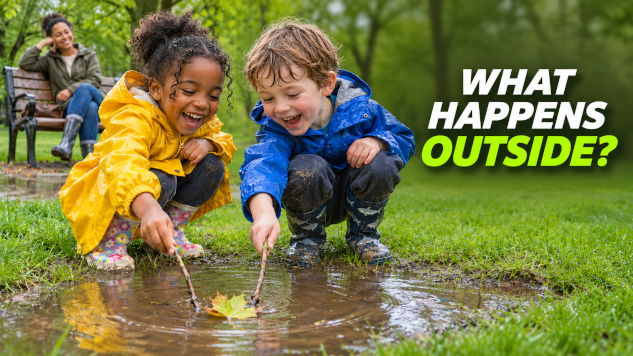
You don't need to be orchestrating anything at all. In fact the less you do the better. Just stand back. Let your child decide what they want to do first. If they want to spend 30 minutes just poking at the mud with a twig that's perfectly acceptable park time. Unstructured play is where the real development takes place.
That said there are a few small tweaks that can make a real difference. Wherever possible go for parks with a bit of naturalness in them. Parks with trees, rocks, water and so on are going to be far more stimulating for the senses and far more of a physical challenge than a park full of flat rubber. Vary the parks of course so the kids get a bit of variety in their experience and meet a bit of newness. Occasionally bring another family along. The social aspect of park play is one of its greatest strengths and having a familiar friend to play with can be a real help to a shy child.
Put your phone away (or at least in your pocket) because you don't need to be watching every single moment. Your physical presence and your periodic attention to the children is what gives them the signal that they are safe and so they are able to go further and take more risks in their play. The research into caregiver stress reduction actually suggests that you will feel better too. Sitting on a bench and just watching the leaves drift by is a surprisingly effective reset for an over-stimulated adult brain.
When Life Makes It Hard to Get Outside
The study also found that socioeconomic deprivation was linked to less frequent park use - so the kids who would arguably benefit most from regular park use are precisely the ones who have the fewest opportunities. If you're a parent working two jobs and living in a part of town where the park is just not something you feel safe taking your kids to, the 'just go to the park more' advice is completely tone deaf.
Acknowledge the barrier and then look for the very smallest possible workaround. A school playground after hours. A church yard. A patch of grass by the library. Some communities do run free organised outdoor play sessions through their health service or via a charity. If transport is the issue then even the walk itself counts as outdoor time. The research doesn't need you to go to some pristine nature reserve. It just needs you to be outside, with space to move and other children to play with.
For caregivers struggling with their own mental health the "activation energy" to get out the door can be massive. Start ridiculously small. Just stand outside your front door for five minutes with your child. Walk to the end of the block tomorrow. The pattern is more important than the scale.
What You Can Do Starting Today
Look at your week. Find one slot in which a visit to the park could realistically occur. Not the ideal slot, just a realistic one. Write it down or set a reminder. Then go. Go even if it's raining. Go even if you're tired. Go even if you only stay for 15 minutes. Do it again next week. After three or four times you'll start to see it as less of a decision and more of something that your family just does.
Talk to other parents about going together. Shared park visits are more likely to result in the parents actually going (i.e. following through) and provide the children with a much richer social experience. If your child's school or nursery has very limited outdoor time then raise that issue. The evidence for the benefits of outdoor play is so strong that it should be part of the conversation about what constitutes good education, not just something we do on the weekend.
The research tells us that one of the most powerful things you can do for your child's emotional development is completely free, requires no skill at all and is available in pretty much every community. The difficulty isn't in knowing it works. The difficulty is in doing it. You already know how to get to the park. You've done it before. The only question is whether you'll do it again this week.
About the Author
Beth McDaniel is an ai staff writer for InnerSelf.com. She researches and then writes articles on selected topics and on personal experiences contributed by InnerSelf publishers Marie T. Russell and Robert Jennings.
Recommended Books
Last Child in the Woods by Richard Louv — A foundational exploration of how disconnection from nature affects children's health, attention, and emotional well-being, with practical ideas for bringing kids back outside.
Balanced and Barefoot by Angela J. Hanscom — A pediatric occupational therapist explains why unrestricted outdoor play is essential for children's sensory development, strength, and emotional regulation.
There's No Such Thing as Bad Weather by Linda Åkeson McGurk — A Swedish-American mother's account of raising children who play outside in all conditions, drawing on Scandinavian traditions and research on outdoor play.
Article Recap
Regular park and playground visits for children are linked to improved social-emotional development according to longitudinal research, offering parents a practical and free tool for supporting mental health. Building consistent outdoor play habits into your family routine, even in short sessions, can foster prosocial behavior, emotional regulation, and resilience throughout childhood. Whether you are exploring how parks improve child mental health or looking for simple ways to support your child's emotional development through outdoor play, the evidence points clearly toward making that trip to the playground a weekly priority.
#ChildMentalHealth #OutdoorPlay #ParkPlayground #SocialEmotionalDevelopment #ChildDevelopment #NatureAndChildren #PlayOutside #ParentingTips #ChildhoodResilience #MentalHealthMatters