
In This Article
- What it means to "rejoin America" and why political parties deserve loyalty only when they serve the people
- How the Republican Party lost its founding purpose and how Democrats confronted their own brutal history
- The corporate counteroffensive that reshaped American politics from the Powell memo through Trump
- Why climate change is the existential test of whether government will protect its own people
- A practical program for 2028 that both parties should be measured against
Let me be absolutely clear about what I mean by "America". I don't mean blind loyalty to whatever the government is doing on a Tuesday. I don't mean some nostalgic version of the past in which everyone was on board and the Founding Fathers had it all worked out. America to me is the promise of democracy: equal citizenship, a government that is answerable to the people and a shared responsibility for the common good.
That promise has never been fully realized. The men who wrote "all men are created equal" were in fact slaveholders. The country which celebrated liberty dispossessed the indigenous peoples of their land, their children and their future. Progress when it came wasn't a gift from the powerful. It was won by the people who were denied their rights, won often at a terrible price and at times won at the cost of their lives.
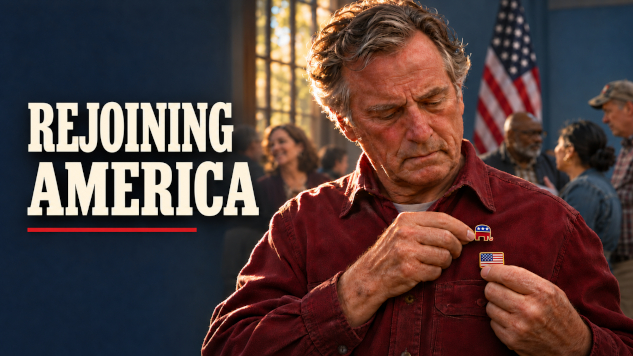
So when I say it's time for the Republicans to rejoin America I'm not asking anyone to become a Democrat. What I'm saying is that a political party is only entitled to your support to the extent that it serves you, protects your future and fulfills the promise of this country to those who have yet to benefit from it.
You can disagree about tax rates. You can disagree about the appropriate size of government. But you cannot abandon equal citizenship, deny the legitimacy of democratic outcomes, reject the weight of scientific evidence and simply walk away from the responsibility of the public for the consequences of your own policies and still claim to be serving America. That is where the Republican Party is today. And that is the problem.
The Election of 1876 and the Loss of Purpose
The GOP was born in opposition to the extension of slavery. Whatever else you want to say about its origins, that's a fact. It was the party of Lincoln who fought a war to save the Union and ultimately to end slavery. During Reconstruction the Republicans in Congress got the 13th, 14th and 15th Amendments passed. They set up governments in the ex-Confederate states which for the first time included Black people as office holders, as voters and as participants in public life. It was all very imperfect, it was all very contentious and it was constantly under violent attack. But it was real.
Then came 1876. The presidential election between Rutherford B. Hayes (Republican) and Samuel Tilden (Democrat) was the subject of disputed returns in a number of states and the matter was settled in early 1877. That settlement effectively brought Reconstruction to an end.
Federal troops were withdrawn from the remaining Southern state governments. Black people were left to the increasingly violent campaign of white supremacist terror. Within a generation the South had in place a complete system of racial subjugation: poll taxes, literacy tests, grandfather clauses, convict leasing and lynching as a form of community enforcement.
Let me be absolutely clear on the issue of responsibility. The Southern Democrats built and ran that system. They wrote the laws, they organized the violence and they maintained the entire apparatus of racial suppression for nearly a hundred years. That is their historical responsibility and that is what the Democratic Party has to carry.

But the Republicans made a choice in 1877. They traded the rights and security of the very people they had fought to free for a political compromise that saw them get the White House. In my view that is where the Republican Party began to lose its soul. Not all at once, not in every state, not in every election.
It was the very founding principle of the party which they were willing to abandon in order to gain political mileage. And once you start down that road the destination is bound to come to you.
The parties themselves survived, their coalitions and their commitments of course evolving over the decades that followed. They must be judged on what they actually did, not on the origin story.
Democrats Rejoin America and Reveal Their Own Contradictions
If you think I'm going to let the Democratic Party off the hook then you haven't been reading very carefully at all. The Democratic Party's history is one of slavery, secession, the enforcement of segregation and the wholesale acceptance of Southern white supremacy for over a century. That's not ancient history. Living Americans will remember the segregated lunch counters, the whites only water fountains and the fire hoses of Birmingham. The Democratic Party was the party of the politicians who built that world and who defended it with their very lives.
The change didn't come about through one man or one moment. It was the product of generations of civil rights activism, of Black people and their allies who simply would not accept what the country was giving them and who insisted on what it had promised. In the context of this argument though, it was the LBJ administration that was the decisive moment.
The Civil Rights Act of 1964 was the law that enshrined equal citizenship and struck at the very foundations of the segregationist legal system. The Voting Rights Act of 1965 was the law that protected the right to political participation for those who had been systematically denied that right. Medicare and Medicaid were the laws that extended the public obligation to provide access to healthcare to the elderly and the poor.
These were not minor adjustments. They ran head on into powerful forces within the Democratic coalition. Johnson is said to have told Bill Moyers an aide that by signing the Civil Rights Act he had handed the South over to the Republican party for a generation. He knew what it would cost. He did it anyway.
And then there's Vietnam. Johnson's disastrous escalation of the war cost the lives of tens of thousands of Americans and millions of Vietnamese. His administration lied about the state of the war, catered to the military-industrial complex and left a wound in the country which has never really healed.
I'm not going to pretend that Johnson's domestic achievements somehow offset the sheer scale of the destruction he caused abroad. The standard I'm applying is the same: domestic achievements which extended rights and opportunities to Americans who had previously been excluded from them are worthy of recognition.
Any military destruction of no legitimate purpose, carried out with deception, is worthy of condemnation. You don't get to pick the column that serves your argument and ignore the other one.
While the federal government was on the march in terms of its obligations to the average citizen, there was a counter-offensive in progress too. That counter-offensive was aimed at strengthening the power of business and at the same time weakening the obligations of the federal government.
The Corporate Counteroffensive Becomes a Political Movement
In 1971 Lewis Powell (the corporate lawyer who was to become a Supreme Court Justice) wrote a confidential memo to the U.S. Chamber of Commerce in which he set out the view that the free enterprise system was under assault from consumer groups, the environmental movement and the regulatory state. His solution was a very broad one indeed: business influence in universities, the media, the courts and the political process. Not a single campaign, but a campaign of influence over the very thinking of the public over a generation.
The memo in itself didn't cause all of that. It was simply the embodiment of a strategy that was already in motion. What happened in the decades that followed was the exponential growth of corporate funded think tanks, legal groups and media outfits. They didn't just advocate for lower taxes and fewer regulations.
They sought to reframe the very nature of the public debate, to make government look inherently incompetent, wasteful and opposed to individual liberty. The very questions that government was asked to answer, the interests that it was expected to protect and the obligations that came with economic power were all the product of this long term campaign.
Reagan's presidency was the one that gave the movement its public face and its most famous slogan of all. 'Government is not the solution to your problem, government is the problem.' During his tenure organized labor was in free fall, deregulation was the height of the thing and the chasm between the rich and everyone else began its long, steady widening. The joke from that era still stands: trickle down economics produced a very considerable amount of wealth. The trickle to you and me, not so much.
Then in came Newt Gingrich. What the corporate strategists hadn't quite anticipated was that Gingrich would take their policy preferences and turn them into the instrument of a total political war. His strategy for 1994 was to nationalize the congressional races, to paint the other side as being morally bankrupt and to make confrontation and obstruction the very essence of Republican politics.
The Contract with America was pitched as a program of reform but the real innovation was the method. The other side weren't just wrong on the policies. They were the enemy of civilization. Once you've got your base convinced of that, compromise is treachery and governance is simply out of the question.
The Tea Party movement (anti-OBAMA) was a movement which combined opposition to the Government with a deep-seated racial resentment and a profound fear of demographic change. It had genuine energy and some of its complaints were quite valid. The movement was however, very much a movement which was funded and promoted by interests whose sole interest was in protecting concentrated wealth rather than in the economic security of the people who were actually at the rallies waving the flags. On Obama’s inauguration night in 2009, Gingrich and other prominent Republicans gathered over dinner to plan united opposition to his economic agenda, a strategy aimed at regaining power by denying him success.
This was not one seamless conspiracy hatched in a single boardroom. It was an evolving coalition of interests, political strategies and cultural fears. The key link is this: racial and cultural division was used to galvanize support for a movement whose economic policies served to increase the concentration of wealth in the hands of a small number of people at the expense of the very people who were voting. That's not a secret. That's a pattern and it's been happening for decades.
Trump as the Culmination Of Un-Americanism
Trump didn't come from nowhere. He simply took the tendencies that were already in place in the Republican Party and amplified them: the racial schism, the disdain for democratic accountability, the preference for loyalty over merit, the chasm between the populist rhetoric and the plutocratic reality. He was louder, more crude and more prepared to say the unsavory bits. But the foundations were there.
The "racist" charge is not a red herring. It's backed up by actual behavior. The Justice Department sued Trump, his father and their company for racial discrimination in housing in 1973, then pursued further enforcement after alleging that the company had failed to comply with the resulting consent decree. He spent years peddling the outright falsehood that Barack Obama wasn't a citizen of the US. He kicked off his 2016 campaign by calling Mexican immigrants 'rapists and criminals'. He described the white supremacists in Charlottesville as comprising 'very fine people'. None of that is a moment that can be interpreted in any other way.
Trump was found guilty of 34 felony counts in the New York hush money case in 2024. He was found liable for sexual abuse in a civil case. He was indicted on federal and state charges relating to his attempts to overturn the 2020 election (though those cases were beset with procedural problems and the fact that he had returned to the presidency). The facts of his behavior as president are well documented.
Within the administration and the party personal loyalty superseded institutional responsibility. Anyone who went against Trump was got rid of. Oversight was viewed as persecution. The entire apparatus of government was turned on its head to reward allies and punish opponents.
And here's the bit that should be most troubling to Republican voters. Trump promised to protect ordinary Americans from a rigged system. His flagship piece of legislation was a tax cut which overwhelmingly benefited the rich and large corporations. The system wasn't un-rigged. It was made more rigged. The anger of the working man was channeled into the immigrants, the minorities, the cultural enemies and the donors got exactly what they paid for. And today leaves us with some 70,000 peoples in concentration camps. Let that sink in for a moment
I want to be very clear about the difference between Republican voters and Republican leaders. A lot of Republican voters have genuine economic grievances, genuine anxieties about the future and genuine frustrations with institutions that have let them down. They deserve honest answers. What they've got instead is blame, blame and more blame, spectacle and policies that make their situation worse. That's not representation. That's a scam.
The implications of this path go far beyond the erosion of democratic institutions and the deepening of economic inequality. They extend right to our very capacity as a species to have a sustainable future on this planet.
Climate Change and the Existential Test
Climate change is a threat to Americans and to humanity. I'm not going to mince my words about that. The scientific evidence is absolutely overwhelming, it's been building up for decades and the impacts are already upon us. Higher temperatures are going to impact food production and water supplies. Sea level rise and more extreme weather are going to impact the very communities we live in. Ecosystem collapse is going to have an impact on the biological systems that we depend upon. The mass displacement of populations is going to have a massive impact on the stability of governments across the globe.
These aren't some abstract projections for the grandchildren of some other person. They're happening right now in escalating fashion and each year we delay reduces the range of responses we have.
The fossil fuel industry and republicans have known for decades about the link between carbon emissions and climate change (their own scientists told them). Their response has been to fund the denial, to manufacture doubt and to obstruct every single meaningful step towards clean energy. The Republican leaders who have been so effectively funded by the industry have in turn been the champions of the denial, the blockers of any real legislation and the ones who have pulled the US out of international climate agreements.
Let me put that as simply as possible. Deliberately obstructing the response to a threat which is itself a threat to your own people is a breach of the most fundamental duty of government. It is not a policy difference. It is not a difference of economic philosophy. It is a breach of the very duty which is the justification for the existence of government in the first place.
Climate action isn't a gift to the environmentalists. It's an obligation to the present and future generations. The workers and communities who are currently reliant on the fossil fuel industries need secure routes forward, real investment in their futures rather than some fantasy that the old economy will go on forever. That's what responsible governance is.
The 2026 Blue Wave as an Opening
The 2026 elections are a chance to turn things around and the indications are that a real shift is in the offing. I should caveat that with a very large dose of realism though. You don't need a mandate for a full-blown progressive platform in order to win a lot of seats in a mid-term election. Some of those votes will be anti-Trump. Some will be driven by local issues. Some will simply be people who want competent government and some basic accountability.
What's important is what the new Congress does with the opportunity. The immediate responsibilities are pretty clear: oversight of the executive branch, accountability for the abuse of power, protection of the institutions that have been so badly damaged and the development of a genuine governing program that will actually address the problems that people face.
Opposition to Trump alone won't build public trust. People need to know what you're for as much as what you're against. The voters who give us a Democratic majority in 2026 are going to be looking for results and they're absolutely going to be looking for results. If the new Congress is going to spend two years on investigations and token votes with nothing of substance coming out of it, that door is going to close.
The 2028 presidential election should be about what government should do and who it should do it for. That's a program election not a campaign election. The program has to be big enough to deal with the real problems America and the world faces.
A New New Deal for 2028
Here's what a serious governing program would look like. Not every detail is going to survive the encounter with political reality. The commitments would be clear and the ambition would be commensurate with the moment.
First and foremost, protect a habitable future. Accelerate the transition to clean energy. Modernize the grid. Improve energy efficiency in buildings, transport and industry. Restore the ecosystems that are currently degraded as they provide such an important degree of natural resilience to the impacts of climate change.
Prepare communities for the climate impacts that are now inevitable. Provide secure, funded transitions for the workers and communities who are currently dependent on the fossil fuel industries. You can't ask people to sacrifice their livelihoods for the good of the whole without providing them with a pathway out of that situation. That's not politics. That's just basic decency.
Secondly, guarantee equal citizenship. Defend voting rights against the concerted campaign to undermine access to the ballot. Defend civil rights. Enforce equal protection under the law regardless of race, gender, sexual orientation or national origin. Make access to public institutions fair and open. That's not some radical agenda. That's the promise the country made and which it has consistently failed to deliver.
Thirdly, make the essentials affordable. Deliver universal healthcare. The US spends more per capita on healthcare than any other developed country and gets significantly worse outcomes. That's not a mystery at all. It's the direct result of a system which is designed to make money rather than to deliver care. Expand access to housing, education, childcare and eldercare. None of those are luxuries. They are the very conditions which allow people to take part in the economy and increase productivity.
Fourthly, disperse economic power. Take on the monopolies which drive up prices, suppress wages and destroy competition. Strengthen the right of workers to collective bargaining so that they actually have a say in the conditions of their own employment. Back small business and co-ops. Open up the opportunity for ownership so that the benefits of growth are not just enjoyed by the very top of the income distribution. Henry Ford worked out that if you paid your workers enough to buy your cars it was good for business. We seem to have lost that lesson completely and are now just handing people credit cards and hoping for the best.
Fifthly, make prosperity bear public obligations. Apply progressive taxation so that those who benefit most from the economy pay their fair share to the society which enables their success. Close the loopholes that allow vast amounts of wealth to escape its obligations. That's not punishment, that's the very essence of the social contract. The greater the economic capacity, the greater the responsibility that should be carried with it, not the greater the immunity.
Sixth, restore accountable government and curtail militarism. Make political spending transparent so that the public know who is spending to buy influence. Tackle the conflicts of interest that allow public officials to profit from their office. Enforce the rules of conduct that have been treated as optional. Examine military expenditure with the same care as any other public expenditure. Give diplomacy and development a greater weighting than military force. The US has a military presence in dozens of countries and spends more on defense than the next several countries put together. Some of that is obviously required. A great deal of it is being spent on interests which have nothing whatsoever to do with the security of the American people.
I need to be very open about one more thing. The Democrats simply can't deliver this program without having to deal with the influence of corporate money within their own party. The same donor class that determines the Republican agenda is the one that funds the Democratic party. Those donations come with strings attached. A party that is going to talk the talk of redistributing economic power and yet take the patronage of such concentrated wealth is going to have a serious credibility issue. You're going to have to have an internal battle to resolve that and most parties would rather not have that. If you don't have that internal battle then you're just going to end up with a program of promises rather than a program of results.
The Invitation to Republicans
I started this piece off by saying it was time for the Republicans to come back into America. I want to go back to that point without in the least bit suggesting that people should register as Democrats. The invitation is actually much simpler. Defend equal citizenship. Accept democratic accountability (which is simply accepting the results of an election and the right of every eligible citizen to vote). Face up to climate change as the crisis that it is. And challenge concentrated power when it is being used to benefit the few at the expense of the many.
You can certainly disagree about how to achieve them. You can put forward very different mechanisms, very different timescales, very different priorities. That's what democracy is for. The foundation however is non-negotiable. Equal citizenship, democratic governance, scientific honesty and a sense of responsibility to the common good are not party positions. They are the absolute baseline for a country that is serious about keeping its word.
Both sides are to blame for where we are. Both sides will be judged on what they do next. America's promise was never self fulfilling. It has always required people to do the work, to pay the price and to be prepared to call out your own side when it fails. The work is not done. The work is in fact the only work that matters.
About the Author
 Robert Jennings is the co-publisher of InnerSelf.com, a platform dedicated to empowering individuals and fostering a more connected, equitable world. A veteran of the U.S. Marine Corps and the U.S. Army, Robert draws on diverse life experience, from real estate and construction to building InnerSelf.com with his wife, Marie T. Russell, bringing a practical, grounded perspective to life's challenges. InnerSelf grew from InnerSelf Magazine, founded by Marie T. Russell in 1985, which became InnerSelf.com in 1996. Decades later, InnerSelf continues to inspire clarity and empowerment.
This article is licensed under a Creative Commons Attribution-NonCommercial-NoDerivatives 4.0 License. You may share it with attribution to Robert Jennings, InnerSelf.com, and a link back to the original article at InnerSelf.com. Commercial use and derivative works are not permitted without permission.
Recommended Books
Democracy in Chains: The Deep History of the Radical Right's Stealth Plan for America by Nancy MacLean — A detailed investigation of how libertarian economists and wealthy donors built a long-term strategy to reshape American democracy in favor of property rights over majority rule.
The New Jim Crow: Mass Incarceration in the Age of Colorblindness by Michelle Alexander — A groundbreaking examination of how the criminal justice system has functioned as a system of racial control long after the formal end of segregation.
The Great Leveler: Violence and the History of Inequality from the Stone Age to the Twenty-First Century by Walter Scheidel — A sweeping historical analysis of the forces that have reduced economic inequality throughout human history and the uncomfortable questions they raise about peaceful reform.
Article Recap
This article examines why it is time for Republicans to rejoin America's democratic promise by confronting the party's abandonment of equal citizenship, climate responsibility, and accountability to ordinary people. It traces the corporate counteroffensive from the Powell memo through the Trump era and proposes a comprehensive governing program for 2028 that includes universal healthcare, clean energy transition, voting rights protection, and progressive economic reform. Both major parties must be held accountable for serving the common good rather than concentrated wealth and political power.
#RejoinAmerica #DemocraticPromise #ClimateAction #EqualCitizenship #VotingRights #CorporateInfluence #NewNewDeal #PoliticalAccountability #EconomicJustice #2028Election