







In This Article
- The five factors Carl Jung identified as the foundation of human happiness in one of his last interviews
- Why Jung warned that every condition assumed to produce happiness can, under the wrong circumstances, produce its opposite
- What modern research from Harvard, neuroscience, and economics confirms about each factor
- Why the fifth factor, a philosophical or religious point of view capable of surviving loss, carries the weight when everything else fails
- The paradox of happiness: why chasing it guarantees you will not find it
In July 1960 Gordon Young, the English journalist, sat down with Jung to talk about what he termed 'the art of living'. Jung was 84 at the time. His health was very poor, Emma having died five years previously and he was well into the period where he had already produced the body of work which was to define psychology for the next century.
Young asked him a rather straightforward question: what are the fundamental factors that contribute to happiness in the human mind? Jung gave five answers. He listed them simply, without any flourish at all, in the manner of a man who had spent a lifetime hearing people talk about their misery and who had worked out a few answers which he was prepared to go on.
Then he added a caveat which completely alters the meaning of the whole list. He died in June the following year, so this was one of the last things he ever said about it publicly. It was a very old man's answer, but it wasn't an answer about old age at all. It was an answer about being alive at any point and trying to do it properly.
Good Physical and Mental Health
Jung came to this first and it's not in any way mysterious. Good physical and mental health. Not perfect health. Not the total absence of suffering. Good health, the sort of health that enables you to get through the day without your own body and mind constantly working against you.
We know it matters. If you've ever been seriously unwell or watched a relative go through the torments of chronic pain you'll know that happiness built on a foundation of sand doesn't last. There's a huge body of modern research to support this, but you don't need any research at all to know that a migraine can completely upend your world and a broken leg can completely change your life.
What's worth noting is that Jung didn't say "perfect" health, he said "good". There's plenty of room in that word for the aches and limitations of being human. The practical implication is straightforward and rather uncomfortable: we are responsible (to the extent that our circumstances permit) for looking after our own bodies and minds. Not as a vanity exercise. As a pre-requisite for all the other things on the list.
Good Personal and Intimate Relationships
The second factor was good personal and intimate relationships of course, i.e. marriage, the family, friendships. Jung was very specific here. He didn't say "social relationships". He named the relationships that actually matter: the spouse, the family, the friends. The kind of relationships in which you actually know the person.
The Harvard Study of Adult Development (which started in 1938 with 724 men and has since grown to over 1,300 of their descendants) has been looking at this very question for the better part of a century. Current director Robert Waldinger puts it this way: relationship satisfaction at age 50 was a better predictor of health at age 80 than cholesterol was. Close relationships, not money or fame, were what kept people happy. That's not some cliche on a greeting card. That's what the data from nearly 90 years of study shows.

It's also one of the toughest items on the list. Good relationships take patience, forgiveness, vulnerability and the sheer willingness to show up when you'd much rather not. You can't buy them, you can't fake them, you can't accrue them like miles on a frequent flyer programme. They can be lost. Jung knew that. He had a very complicated marriage and a very complicated set of friendships. He put relationships in second place not because they were easy or guaranteed but because they matter so immensely.
The Faculty for Perceiving Beauty in Art and Nature
Jung's third factor is the one that actually surprises people: the capacity to perceive beauty in art and in nature. It's not about creating art, it's not about owning art. It's about the ability to perceive beauty. To see it. To let it in. To be moved by something that is entirely outside of yourself.
There's a growing body of work on this. Virginia Sturm, Dacher Keltner and colleagues published a study in which healthy adults aged 60-90 took 15 minute walks every week for eight weeks. Half of the participants were told to walk with the intention of having an awe experience. The group who walked with the intention of having an awe experience reported more joy and prosocial emotion and less daily distress.
Over time their selfies started to show less of themselves and more of the environment around them. It was a very small study (52 people), so it's more of a promising finding than a proven one. The direction of the trend is, however, very clear. Looking outwards with attention and openness has an effect on us.
A larger study by Matthew White and colleagues (published in Scientific Reports 2019) looked at just over 20,000 people in England and found that spending at least 120 minutes a week in nature was associated with better self reported health and wellbeing.
Under 60 minutes showed no benefit. The benefit peaked at 200-300 minutes and it made no difference whether that was one long session or several shorter ones. The authors are very clear to say this is a correlation not a proof and that's an honesty that should be acknowledged.
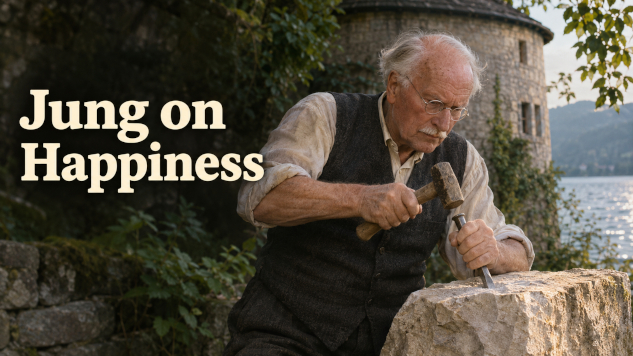
Jung understood that himself. After his mother died in 1922 he bought land on the upper basin of Lake Zurich and from 1923 onwards began building a round stone tower at Bollingen. He worked with the masons and did some of the stonework himself, adding to it over the years. It was no retreat from life at all. It was a place where the experience of beauty in stone, in water, in the firelight could be lived in every day. He reportedly lived there without any electricity, drawing water, chopping wood and tending the fire himself. The simplicity was the point.
Reasonable Standards of Living and Satisfactory Work
Factor four is the one that people either just brush past or misread: reasonable standards of living and satisfactory work. Note the word 'reasonable'. Jung by no means was dismissing the importance of material comfort. He was in no way suggesting that money is irrelevant (that's the only thing comfortable people will ever say with a straight face). What he was saying was that 'enough' matters. Not 'more'. Enough.
The research into money and happiness has gone through several iterations. The 2010 study by Daniel Kahneman and Angus Deaton found that everyday emotional wellbeing plateaus at about $75k household income. The 2021 study by Matthew Killingsworth found no such plateau. In their head-to-head study published in PNAS last year (one of Kahneman's final papers) they settled it thus: for the vast majority of people, happiness does continue to rise with income.
But for the least happy fifth the gains level off at around $100k. For the happiest fifth the gains actually start to accelerate past $100k. A subsequent reanalysis has argued for a general plateau around $200k. That's all rather consistent with what Jung knew all along really. Money is important, the impact of money varies from person to person and it doesn't in any way magically fix unhappiness.
The 'satisfactory work' half of that factor is just as important. Jung wasn't talking about prestigious work or high paying work or work that will get you noticed at dinner parties. He was talking about work that is satisfactory. Robert Waldinger, again drawing on the same Harvard data, has observed that work which is meaningful to the individual is the thing which is associated with happiness (whereas prestige alone is not). That's entirely in keeping with what we know about purpose and engagement. The question isn't 'what do you do?' The question is 'does what you do feel worth doing?'
A Philosophical or Religious Point of View
The fifth factor is the one that holds all the others together when they fall apart. It's a philosophical or religious outlook which is able to cope with the vicissitudes of life. That word "vicissitudes" is doing a lot of work. It means the unpredictable changes, the losses, the reversals, the moments when your health gives out and your relationships end and beauty recedes and the work dries up. Jung is asking: when you've had all of the first four things taken from you, what do you have left?
In 1959 the BBC interviewer John Freeman asked Jung on the Face to Face program whether he believed in God. Jung paused and said "I don't need to believe. I know". Whether that's theologically acceptable or not, it was no ordinary answer. It was the answer of a man who after decades of inner work and clinical experience had arrived at a position which he could stand on when the ground shifted.
Research supports the link between purpose and longevity. Hill and Turiano (Psychological Science, 2014) looked at data from over 6,000 people in the MIDUS study and found that those who had a greater sense of purpose in life lived longer over the 14 year follow-up at every age and whether or not they had retired. Purpose wasn't a luxury, it was protective.
In 1950 a cornerstone was delivered to Bollingen the wrong size. Jung kept it. He carved some inscriptions into it and put it in his garden. He didn't go back and get a replacement. That was Factor Five in action. Not optimism. Not denial. The ability to take what comes and make something of it.
The Warning Most People Leave Out
Here's the bit that changes it all. In the same interview Jung didn't just hand over his five factors and be done with it. He said that all the factors which we normally think of as being the ingredients of happiness can, under certain conditions, actually be the ingredients of unhappiness. He said that no situation however ideal will guarantee happiness. He said that the more you deliberately go in search of happiness the more certain you are to fail to find it. And he said that a relatively minor disturbance of the biological or psychological equilibrium is quite sufficient to destroy it.
Read that again. The chap who just laid out five conditions for happiness then went on to say that none of them are in any way reliable. That even the best version of each one can fail. That the only way to be sure of missing the feeling is to chase it directly.
This is not pessimism. It's honesty and it's exactly what the research into the 'pursuit of happiness' as an end in itself has shown. If you treat happiness as a goal to be achieved then you tend to become more dissatisfied than you otherwise would. You start measuring your emotional state against an expectation and the gap between the two is in itself a source of unhappiness. Jung's advice was very different: just take things as they come with patience and equanimity. That is not passivity. That is a discipline.
What Holds When Everything Else Gives Way
There's a reason Jung listed five factors rather than four. The first four can all be lost. You can lose your health. People die or simply walk away. The capacity for beauty will be eroded through sufficient grief. Work will cease. None of those are pessimistic forecasts. They are simply descriptions of what happens to human beings over the course of a life. The fifth factor (the point of view which allows you to endure the ups and downs of life) is the only one which is not contingent upon the external world remaining in a state of favor. It's the one you build in.
Jung didn't promise it would be easy or pleasant to build. He'd spent his whole career working with people whose inner lives were in a state of complete chaos and he knew that the process of constructing meaning is often painful, very slow and very uncertain. He also knew that it was the one thing which would survive when the other four had all gone. It was the fire you tended when the lights went out.
We live in a culture that sells happiness as a product. Buy this, do this, optimize this and you'll feel the way the ads tell you you should. Jung at 84, with less than a year to go, said something far simpler and far harder. Here are five things that matter. Hold them loosely. Don't chase the feeling they produce. And build into yourself a way of seeing that can survive the loss of any of them. That's not a recipe. That's the closest thing to wisdom an honest person can possibly offer.
His five factors are worth remembering. His warning is worth remembering even more.
Recommended Books
Memories, Dreams, Reflections by Carl Jung — Jung's autobiography, recorded and edited in his final years, offering his own account of the inner and outer events that shaped his psychology.
The Good Life by Robert Waldinger and Marc Schulz — The directors of the Harvard Study of Adult Development distill nearly nine decades of research into what actually makes people happy.
Awe: The New Science of Everyday Wonder and How It Can Transform Your Life by Dacher Keltner — A psychologist explores the science behind experiences of awe and their measurable effects on wellbeing and connection.
Article Recap
Carl Jung's five factors for happiness, shared in one of his final interviews in 1960, remain remarkably well supported by modern psychological research on health, relationships, awe, meaningful work, and purpose in life. The warning Jung attached to his list, that deliberately pursuing happiness ensures you will not find it and that even ideal conditions can produce the opposite, is the part most retellings leave out and the part that matters most. Building a philosophical or religious point of view capable of surviving loss may be the most important factor of all when health, relationships, beauty, and work are taken away.
#CarlJung #HappinessResearch #MeaningOfLife #PersonalGrowth #PurposeInLife #Mindfulness #PositivePsychology #InnerWork #Wellbeing #SpiritualDevelopment