In This Article
- Why California's rejected wealth tax was the wrong way to frame a real public need
- What taxes actually do, and why the deeper issue is shared responsibility rather than simple revenue
- How gated withdrawal, climate risk, and public anger feed each other
- Why progressive taxes should apply to property, consumption, and luxury spending
- How local control, antitrust enforcement, and public election financing can check concentrated power
The California failed wealth tax proposal was the most inept way of raising a perfectly legitimate point. We all need health care. Communities need to be funded. But to fund that through a one-off levy on a few hundred billionaires was just the most absurd thing you could do. It was bad policy, it was bad politics and it was a masterclass in how to turn a serious public duty into a food fight about whether the rich are good or bad or saintly or greedy or lucky or all of the above before lunch.
That's the trap. As soon as you start the debate with a list of people who are billionaires you're no longer talking about public rules, you're talking about personal virtue. The supporters can then go on to treat wealth itself as a sign of something wrong. The rich, some of whom have built companies that people actually care about, hear every call for responsibility as a call to take away what they have. Then the whole thing becomes rather stupid. We start arguing about people when we should be arguing about obligations.
A dollar figure on its own tells you far less than people would have you believe. Some fortunes are made by creating useful products and services. Some are inherited. Some are the result of market power, tax breaks, monopoly status or simply being in the right place at the right time when the rules were being written. Some owners use their wealth to invest in and improve the communities they live in. Others treat citizenship as if it's for the people who don't have a jet. So no, the figure in itself doesn't answer the moral question. It does, however, raise a very practical one. What should society expect from people who have the greatest freedom to act as a result of their wealth?
Why California Got It Wrong
Cal voters have rejected Prop 40 which would have imposed a one-off tax of up to 5% on the covered wealth of certain billionaires, with the proceeds going to health care. The need for health care is very real. People get sick every day, not just during the course of a special tax event. If you have an ongoing public need then you should fund it via ongoing rules rather than a dramatic one-off raid which sounds like policy written by a fundraising consultant after a few too many coffees.
The real problem was the way the measure framed the issue. It wasn't simply asking people whether California needed revenue, it was asking them whether a very small number of very wealthy people were entitled to keep what they had. That was an argument designed to generate heat rather than light. It was an argument which almost guaranteed both sides would caricature the other. The billionaires would be the cartoon villains and any call for a broader contribution would be dismissed as envy in sensible shoes.
A proper tax system shouldn't be based on rage and it shouldn't demand sainthood from its citizens. It should be a system that establishes clear, stable expectations over time and under known rules. If we're going to pay for health care, schools, infrastructure, disaster relief and the basic fabric of society then we need to ask how the tax system as a whole embodies that. A one off tax on covered wealth may be a good way to generate political excitement, but excitement is not a budget and it's absolutely not a social contract.
There's also a very practical political lesson in all this. A policy based on the idea of the rich as a class enemy will no doubt get you a rally. It will probably have the opposite effect of what you intend though in that it will just harden the resistance you're trying to break down. Once the wealthy have the sense that the real object is to strip them of their wealth because they are wealthy rather than to establish fair public rules then they will respond in kind.
They will go to lawyers, accountants, lobbying shops, residency plans, shell companies etc. It's fascinating how quickly people discover the value of constitutional principle when their own portfolio is at stake. If the objective is to achieve genuine participation then that is a very poor way to go about it.

Why Tax Anyone At All
Most tax debates start and finish with the question of revenue. How much will it raise? Will it grow the economy? Will it reduce the deficit? Those are legitimate questions but they aren't the whole story. In simple terms federal spending puts money into the hands of private citizens and federal taxes take money out of the private sector. So every tax decision is also a decision about whose purchasing power is going to be reduced, by how much and for what broader purpose.
My answer is simply this: a tax system should be one which encourages the better off to contribute more to the society in which they live. Of course the issue of demand, inflation, spending and the like is important. But the moral issue is the one beneath the technical one. What do we owe each other in a shared economy, shared public institutions and shared fate whether we like our neighbors or not?
Two things can be true at the same time (and our politics is frankly the maturity of a middle school cafeteria and often won't admit it). A person can absolutely be entitled to credit for building a successful business, for taking risks and for working hard. That same success can still be predicated on the existence of a public education system, of a system of law which protects the consumer, of roads and ports built with public funds, of a judiciary which enforces contracts, of a currency which is trusted by all and of a social peace which is maintained by institutions which no individual billionaire could possibly provide. You don't ship goods over a private interstate. You don't recruit from a private civilization.
That's why the real question isn't who 'deserves' their fortune in some mystical sense. The real question is what obligations are there in using extraordinary wealth in a society which is the very reason that wealth exists in the first place. Once you put it that way, taxation stops being a morality tale and becomes a set of rules for participation.
Participation matters because money isn't just comfort. It's options. It's insulation. It's the ability to avoid the consequences that hit everybody else so hard. That's precisely why the people with the most means can shoulder the greatest public responsibility without in any way losing their basic freedom. In fact their basic freedom is usually very well insulated.
The Pitchforks And The Gated Retreat
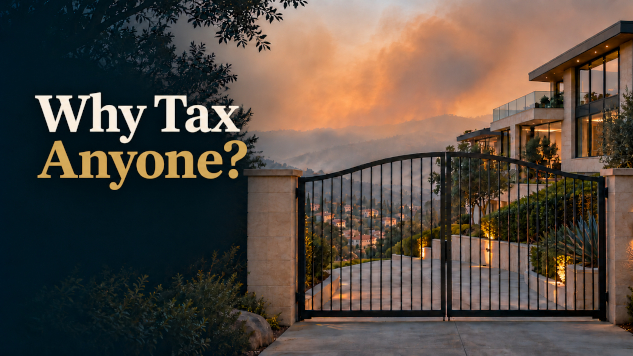
So many of the wealthy are not blind. They can see the anger being generated over housing costs, failing services, the state of the infrastructure, the cost of health care, the climate risks and the sheer awfulness of the politics which looks more like an auction than a republic. Their response in many cases is perfectly sensible from the point of view of someone inside the armored SUV. Buy another house. Get private security. Sign up for the airport lounge of the damned. Make sure there's somewhere else to go if things go wrong.
To them it looks like prudence rather than selfishness. If you can afford backup systems why wouldn't you buy them? If one town is on fire, under water, blacked out or just generally going off the rails why not spend your way out of it? On an individual basis that's perfectly reasonable. People with means generally buy options. That's what having means is for.
Now look at it from the other side of the gate. If the average person is finding it hard to afford rent, to pay for insurance, to find child care, to get medical treatment, to trust the water they're drinking, and then they see the rich going out and buying private alternatives to every single one of those things, what do they think? That the people with the most money have effectively decided that the commons is not for them. That the commons is for suckers. That there are two societies now, one with the exits and one with the excuses.
The attitudes feed off each other. Public anger leads to withdrawal. Withdrawal in turn is proof that the rich don't care about the world beyond their own driveway camera. Then along comes some political maverick with a campaign against the billionaires and the cycle is one notch tighter. More fear at the top. More resentment at the bottom. More money in politics. Less trust in any direction.
The rich still have a vested interest in whether local schools work, whether the workforce can afford to live in the area, whether the public health service can cope in an emergency, whether the roads will be passable and whether the institutions themselves can survive under pressure. That interest doesn't go away just because there's a private school, just because there's a second home on higher ground, just because there's a generator going behind the hedges. Private alternatives don't get rid of the public dependency. They just postpone it.
That's the bit that some of the rich miss and some of the tax activists miss in a rather different way. Participation isn't simply about payment. It's about recognition. It's about acknowledging that you are still part of the fate of people you may never have met and systems which you never actually designed. You can certainly shield yourself from some of the more immediate irritations. You can't shield yourself from a failing society for ever. History keeps the receipts.
Climate Change Ends The Fantasy Of Private Escape
Take the owner of three large houses. One by the coast. One in the mountains. One somewhere inland where the brochures are all about resilience and the estate agent is beaming with a mortgage in hand. If the first of those properties is threatened by wildfire, flood, drought, storm surge or a prolonged power failure then the second or third can provide a real safety net. That flexibility is important. Money can buy you time, mobility and a margin of error. There's no denying that.
But take that person to the safer house and the fantasy starts to fall apart pretty quickly. They still need food grown somewhere by someone. They still need the truck routes, the power grids, the communications networks, the emergency services, the insurance, the construction labour, the clean water and the local government with sufficient staff and sufficient funds to keep things from just going to pieces. The house may be private but the conditions which make life in it possible aren't.
Even recovery is social. You can't just get rich and magically create a working supply chain, enough workers, a stable region etc. If the surrounding communities are all in tatters then roads that have been washed out for everyone are still washed out. A hospital that is overwhelmed is still overwhelmed. A utility grid that is under strain doesn't ask to see your brokerage statement before it fails.
The real question for the well off when it comes to preparation is not whether they get an exit. Of course many will. The question is whether they use that exit to simply get themselves out of the mess, or whether they also use it to improve the places they and everyone else depend on. That's where responsibility ceases to be a theory and becomes practice. You can use your wealth as a ladder out of the mire, or you can use it as a reason to help make the floor we all stand on a bit more solid.
Climate change makes the point absolutely - it's the perfect example of the limits of private fixes. You can have wealth and use it to get yourself away from a particular fire, a particular storm, a particular outage. You can't use it to get yourself into a separate atmosphere. You can't use it to get yourself into a separate harvest. You can't use it to get yourself into a separate labour force that's not going to be disrupted. The people who have the most options have both a moral imperative and a practical self interest in making the system more resilient. It's rather amusing really how often those two are presented as being in opposition when in fact they're very much allies.
Make Every Tax Progressive
Here's the principle that should be doing far more than it currently is. We should be taxing according to the nature of the claim the purchase or asset makes on the common pool of resources. The more luxurious the claim, the steeper the rate should be. That's not in any way a complicated principle. Why should the tax on someone's third 10,000 sq ft house be the same as the tax on the rather modest house that another family can barely afford? Paying more dollars simply because the house is worth more is not the same as paying a higher rate because the purchase itself is a more luxurious claim on land, labor, energy and materials.
Florida is a good example (though it doesn't go far enough). They've got a larger homestead exemption for non-school property taxes, coming up to $250k in 2028. The fixed exemption shelters a greater proportion of the assessed value of a modest home than of a more expensive one. So with one rate above the exemption you end up with a more progressive effective tax rate as the value of the home increases. That's a perfectly sensible first step in that it acknowledges the difference between a home as a place of basic shelter and a home as a high end property. It should not be the end of the story though.
A genuinely progressive property system would be asking much more direct questions. Is this a primary residence (i.e. first home) or a second or third personal property? Is it a modest dwelling or a luxury estate? Is it a property which is meeting a basic need or is it simply an additional consumption good for someone who is already well and truly supplied with roof space? The social purpose is very different in each case. A first home is in the realm of necessity. A third mansion is not an indication of hardship in any way. No-one is sleeping in a 10,000 sq ft backup plan.
Renters must be part of this conversation not an afterthought. A modest apartment is fulfilling the same fundamental human need as a modest owner occupied property. The fact that the property tax bill goes to the landlord doesn't in any way change that. A building full of ordinary apartments is providing housing. A luxury property held as a personal retreat or as a status symbol of some kind is serving a very different function. Good tax policy should be about use not just about the paperwork.
The same principle applies at the till. Exempt the essentials. Tax your normal purchases lightly. Apply the heaviest rates to the luxuries. The rate should be a function of the purchase not the person making the purchase. A billionaire buying groceries should be taxed in the same way as the rest of us buying groceries as groceries are groceries. A private yacht, a designer watch that costs more than a teacher's salary or a six figure kitchen renovation in house number three are not essentials in the slightest and are only the product of modern day vanity.
This principle should also apply when people are trying to hide the luxury in a business expense. A luxury car purchased with company funds is still a luxury purchase. Putting the company name on the invoice doesn't in any way turn a luxury into a necessary expense. One of the oldest tricks in the book is to socialize the tax benefit and privatized the comfort. We know the game. The leather seats are absolutely essential to innovation. Spare me.
A progressive system structured in this way has a useful political effect as well as an economic one. It moves the debate away from the rather crude notion of punishing the rich as people and towards the more sensible argument of taxing luxury claims as luxury claims. It protects the basics first and then asks for more as the claim increases. If you can afford the third mansion, the jeweled toy, the company billed pleasure machine etc then you can afford to have a higher percentage of it returned to the society which made the purchase possible in the first place.
Give Local Voters More Control
There's also a better way to support local communities than to have them squeeze the ordinary household while the federal government hoards its fiscal capacity and then go on to lecture the country about discipline. Just send the state and local governments the same amount per capita and let the local voters decide how to spend it. That would give communities the space to reduce the tax burden on working and middle income households, while still being able to fund schools, public safety, transit, parks, health services and all the other unglamorous bits of local government.
This doesn't mean that every local government will be wise with their spending. Some will do better than others. Welcome to democracy. Local voters are in a far better position to judge whether the money has actually improved their town, their county or their city than they are to parse through all the endless federal platitudes. If Washington can help carry the burden then local communities can decide what they want to prioritize. That's not central planning. That's giving people the chance to govern the places where they actually live.
It also removes the constant pressure to be reliant on the taxes that most directly hurt the average person (whether that be via the cost of housing, various fees or otherwise) and to do so under the guise of fairness as if that's what it's all about. If we want a tax system that actually respects basic needs then communities need the fiscal space to stop taxing those very basic needs to such an extent.
Deal Directly With Concentrated Power
Tax policy can't do it all. If a company is using its market power to keep the competition out then you deal with that via antitrust. If a small number of firms are able to set prices, eliminate suppliers, corner labor markets or otherwise set the terms of local life then that's not just a tax issue. That's concentrated private power doing what concentrated private power always does when it's left to its own devices. It writes the rules for everyone else and then calls the result 'efficiency'.
The same is true of politics. If candidates are reliant on large private donors then public policy is going to continue to stink of donor maintenance regardless of how many speeches they give about the middle class. Public election funding is the direct answer to one of the principal ways in which wealth translates into power over others. If we are serious about equal citizenship then we cannot continue to pretend that everyone has an equal voice whilst some people come to the table with megaphones made of money.
These reforms are to be seen alongside progressive taxation not in place of it. The same rules should apply to anyone buying a luxury, to anyone running a business and to anyone seeking public office. It's the shared rules that are the point. Taxes can be a mechanism for shaping participation. Antitrust can be a mechanism for ensuring fair competition. Public financing can be a mechanism for ensuring fair democratic choice. Each of those is a way of saying that freedom in a republic is not the freedom to simply buy your own lane through every public institution.
The Third House And The First Obligation
So we're back where we started. California asked whether certain billionaires should pay a one-off tax on what they own. That was the wrong way to frame the issue. The real issue is what people with wealth owe to the society in which they live on an annual basis and how that obligation should be reflected in rules that are stable, transparent and fair enough to be defended without recourse to torches or halo polishing.
Think of three households. The renter has a need for a home. The homeowner has a need for a home. The owner of three mansions is making a claim on land, labor, energy and materials which is substantially greater than either of the first two. A progressive system should start with the basic need and then ask for more as the claim increases. That is not class warfare. That is simply adult bookkeeping combined with a sense of civic morality.
Bring the gates back for a moment. The owner of that third home may well have legitimate grounds for concern about the world outside. Property prices are going up. Climate risks are escalating. There's a general lack of trust in the institutions we have. Fair enough. That concern could be a reason to get involved in the business of making the wider community safer and more resilient rather than less. If you're worried enough to buy an exit, you might just as well be worried enough to help in the business of making the road that everyone else still has to use a bit safer.
That's the essence of it. Taxation is not simply about raising revenue. It's about defining the kind of society we are prepared to live in. Is it a society in which the wealthy simply buy their way around public failure and call that a success? Or is it a society in which extraordinary means are coupled with a greater responsibility to sustain the common world? Nobody gets rich in a vacuum, however much myth we can afterwards pour over the tale.
You can buy a third house. You can buy a wall, a gate, a backup generator and a very calming view from the terrace. But when you walk out the front door you still need a society to live in. The rest is just expensive staging.
About the Author
 Robert Jennings is the co-publisher of InnerSelf.com, a platform dedicated to empowering individuals and fostering a more connected, equitable world. A veteran of the U.S. Marine Corps and the U.S. Army, Robert draws on diverse life experience, from real estate and construction to building InnerSelf.com with his wife, Marie T. Russell, bringing a practical, grounded perspective to life's challenges. InnerSelf grew from InnerSelf Magazine, founded by Marie T. Russell in 1985, which became InnerSelf.com in 1996. Decades later, InnerSelf continues to inspire clarity and empowerment.
This article is licensed under a Creative Commons Attribution-NonCommercial-NoDerivatives 4.0 License. You may share it with attribution to Robert Jennings, InnerSelf.com, and a link back to the original article at InnerSelf.com. Commercial use and derivative works are not permitted without permission.
Recommended Books
The Sum of Us by Heather McGhee — A clear and compelling look at how public disinvestment and division harm everyone while enriching a narrow few.
Capital in the Twenty First Century by Thomas Piketty — An influential examination of how wealth concentrates over time and why democratic societies struggle to respond.
The Deficit Myth by Stephanie Kelton — A provocative explanation of federal spending, taxation, and public purpose that challenges conventional budget politics.
Article Recap
This article says that California's one-off wealth tax was a terrible way to deal with a genuine public need as it turned what should have been a shared responsibility into a battle over whether the billionaires are entitled to what they own. The better approach is a progressive tax on housing, on luxury consumption and on corporate perks which puts the basic needs of people first and then asks for more from the larger claims on the resources of society.
It's also why the rich can't actually get away from the failing public systems (in an age of climate disruption) and why fair taxation, local democratic control, anti-trust and public election financing all belong in the same discussion about wealth and responsibility in a shared society.
#TaxJustice #WealthResponsibility #ProgressiveTaxation #EconomicFairness #PublicGood #ClimateResilience #HousingJustice #Antitrust #DemocracyReform #SharedProsperity