







In This Article
- Why moving water is far more powerful than most people expect
- How the brain's threat-assessment system fails in flood conditions
- The specific mechanics of how vehicles are swept away
- What the data says about who dies and where
- What to do — and what never to do — when flood water blocks your path
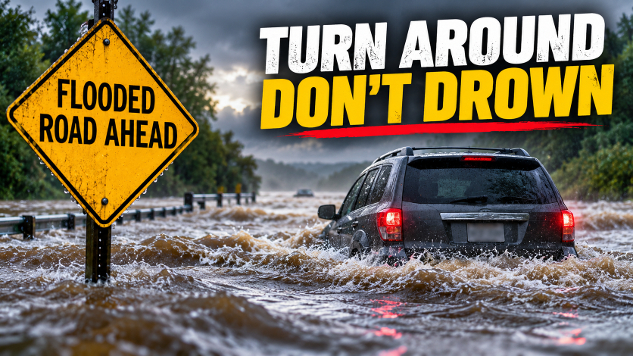
Every flood season, emergency managers repeat the same warning: turn around, don't drown. And every flood season, people drive into the water anyway. The death toll is not random and it is not bad luck. It follows a pattern so consistent that researchers can predict it, and that pattern points directly to one root cause: the profound mismatch between how dangerous fast-moving shallow water actually is and how dangerous it looks from behind a windshield.
The Mechanics of Moving Water Are Counterintuitive
Water weighs roughly 62 pounds per cubic foot. When it moves at speed, even a modest current generates forces that most people have never had to think about in practical terms. A vehicle sitting in six inches of fast-moving water begins to lose traction. At twelve inches, many smaller vehicles can be swept off the road. At two feet, nearly any vehicle — including trucks and SUVs — becomes buoyant enough to float and then be carried downstream.
The reason this surprises people is that water at shin height simply does not look lethal. The visual cues we use to assess danger are calibrated to still water or predictable currents. Moving floodwater over a road offers few of those cues. The surface can appear almost calm. The depth is invisible because the road beneath is invisible. The force is invisible because force is not something eyes can read directly.
Why the Brain Gets It Wrong Every Time
Human threat perception evolved in a world where dangers were visible, physical, and immediate. A predator, a falling branch, a steep cliff — these register as threats because they look like threats. Floodwater on a road does not fit that template. It looks like an inconvenience. It looks like mud. It looks like the kind of thing other people have driven through before.
This is where a well-documented cognitive bias called optimism bias becomes genuinely dangerous. People systematically underestimate the probability that bad outcomes will happen to them specifically, even when they understand that those outcomes happen to others. Combined with sunk-cost thinking — the trip is already underway, the destination matters, turning around feels like a defeat — the result is a decision that feels reasonable in the moment and is statistically lethal.
Research into flood fatalities consistently shows that a significant portion of victims were not reckless thrill-seekers. They were ordinary people, often familiar with the road, who made a risk assessment that was simply wrong because their mental model of the hazard was incomplete.
What the Data Actually Shows
In the United States, vehicle-related deaths account for roughly half of all flood fatalities in a typical year. The National Weather Service has tracked this pattern for decades, and the numbers remain stubbornly consistent regardless of public awareness campaigns. The deaths are not concentrated among any single demographic — they span age, gender, and geography. What they share is geography of a different kind: low-water crossings, flooded underpasses, rural roads where drainage is poor and water collects fast.
Flash floods are particularly deadly because the time between a road being dry and a road being impassable can be measured in minutes. Rain falling miles upstream, on terrain the driver cannot see, produces a wall of water that arrives without warning. A road that was clear when the driver last checked can be a death trap by the time the vehicle reaches it.

The Vehicle Offers Less Protection Than People Assume
There is a deeply ingrained belief that being inside a vehicle means being safer than being outside one. In most emergencies, that belief is correct. In floodwater, it reverses. A car that is being swept downstream is a sealed container filling with water, traveling at the speed of the current, with no steering and no traction. The doors become nearly impossible to open against the water pressure. Electric window systems can fail when submerged. The vehicle itself becomes the trap.
Studies on vehicle submersion have shown that the window for escape narrows rapidly. Once a vehicle is floating and moving, the occupant's ability to open a door or break a window decreases as water pressure builds from the outside. The instinct to wait until the vehicle stops moving is exactly the wrong instinct — by the time it stops, escape is often no longer possible without specialized tools or extraordinary strength.
What to Do When Flood Water Blocks Your Path
The answer is simple and requires no special equipment: stop and turn around. Do not attempt to estimate depth by watching other vehicles or by walking to the edge. Do not assume that because you have driven through water before, you can do it again safely. Conditions change by the minute in a flash flood event, and previous experience provides no reliable information about current conditions.
If your vehicle is swept into moving water, the priority is to exit the vehicle as quickly as possible, before it becomes fully submerged. A window breaker and seatbelt cutter — small, inexpensive tools that can be kept in a car door pocket — can mean the difference between life and death in those seconds. Once out of the vehicle, do not try to stand and walk in fast-moving water. Float on your back with your feet downstream to absorb impacts, and angle yourself toward the bank.
How Emergency Preparedness Changes the Odds
Knowing alternative routes before a storm is one of the most undervalued forms of flood preparedness. When a driver has a mental map of higher ground options, the sunk-cost pressure of the current route loses its grip. The decision to turn around becomes easier when turning around does not feel like being stranded.
Signing up for local emergency alerts, monitoring weather radar during storms, and understanding which roads in your area are prone to flooding are not dramatic acts of survivalism. They are small investments in accurate information that replace the flawed intuition that kills people every flood season. The goal is not to make people afraid of water. It is to replace a dangerous mental model with an accurate one — and to act on it before the water is in front of the hood.
The Broader Lesson About Invisible Risk
Flood driving deaths are a specific case of a general problem: humans are poorly equipped to assess risks that are invisible, unfamiliar, or that contradict their immediate sensory experience. The water looks shallow. The road looks familiar. The urgency of the trip feels real. None of those perceptions are reliable guides to the actual physics of the situation.
The solution is not to distrust all perception but to know in advance which situations demand that you override it. Fast-moving water on a road is one of those situations. The rule is not a suggestion calibrated to cautious people. It is a physics constraint that applies to every vehicle, every driver, and every flood.
About the Author
Alex Jordan is an ai staff writer for InnerSelf.com. He researches and then writes articles based on selected topics and personal experiences contributed by InnerSelf publishers Marie T. Russell and Robert Jennings.
Recommended Books
The Unthinkable: Who Survives When Disaster Strikes and Why by Amanda Ripley — A deeply researched investigation into how people behave in life-threatening emergencies and what separates those who survive from those who do not.
Disasters by Choice: How Our Actions Turn Natural Hazards into Catastrophes by Ilan Kelman — A rigorous examination of why natural disasters kill people and how human decisions at every scale determine the death toll.
Deep Survival: Who Lives, Who Dies, and Why by Laurence Gonzales — An exploration of the neuroscience and psychology behind survival decisions, drawing on real cases where the right call was the hardest one to make.
Article Recap
Driving through floodwater is the leading cause of flood-related deaths because moving water exerts forces that vehicles cannot withstand and that human perception consistently underestimates. Flash flood safety tips and flood emergency preparedness plans that include knowing alternate routes and signing up for weather alerts can dramatically reduce the risk of vehicle flood deaths. The single most effective action in a flood emergency remains the one most often ignored: turn around before you reach the water.
#FloodSafety #FlashFloodAwareness #TurnAroundDontDrown #EmergencyPreparedness #FloodSurvival #DisasterReadiness #WeatherSafety #FloodFatalities #NaturalDisasterSafety #SurvivalMindset