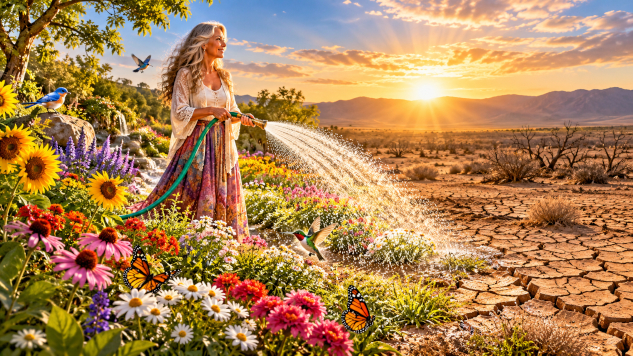
Bringing a parched garden back to life.
In This Article
- How an unexpected encounter with a grieving stranger revealed the healing power of love.
- Why helping others requires compassion, intuition, and recognizing the difference between helping and enabling.
- How looking beyond appearances allows us to truly see the people around us.
- Why choosing love over fear doesn't mean abandoning healthy boundaries.
- How small acts of kindness can help transform our lives and heal a world in need of love.
I was told the other day that I was trying to help too much. And my reply at the time was that there are only two choices, and that is helping or not helping. There is no in-between. You're either helping or you're not. There is no neutral ground because neutrality equates to not helping.
However, upon reflection, I do acknowledge that there is such a thing as helping too much, and that's usually called enabling. Sometimes we try to help to the point where we either take over the other person's responsibility and do things for them, or we don't allow people to help themselves because we are doing the work for them.
And perhaps that's an important distinction. Helping someone is not the same as doing things for them. Sometimes the greatest help we can give is to let someone find their own way, make their own choices, and learn from their own experiences. So perhaps the question is not only whether we are helping, but whether what we are doing is truly helpful.
But for the case of this discussion, let's assume that we are not speaking of enabling or taking over someone's responsibility, but simply sharing our energy and our love, by helping the other person in whatever way we are guided to.
An Unexpected Encounter at the Drugstore
The other day I had an experience at the local drugstore which was a blessing not only to the other person but also to myself.
Because of the way this particular checkout system is set up in the store, the line can extend out into one of the aisles. So as I came around and saw a person in the aisle, I walked up to her and said, "Are you the end of the line?"
And she said yes, she was. I got in line behind her, and then commented, "Well, now I'm the end of the line and you're the middle." I was just making conversation and finding a way to connect in another human encounter.

As I said "end of the line", it reminded me of one of my favorite songs, "End of the Line," by the Traveling Wilburys, a group of friends which included George Harrison, Roy Orbison, Tom Petty, Bob Dylan, and Jeff Lynne.
So I asked her, "Oh, do you know that song, 'End of the Line'? It's a great song."
And she replied yes, which then prompted me to tell her about the video of that song, where, because Roy Orbison had died between the recording of the song and the creation of the video, he is represented by an empty rocking chair which slowly rocks throughout the video.
So I was sharing this with her, a stranger in line with me at the store. And I said, "Oh, you have to watch that video. It's so good. It's awesome!" I started getting goosebumps as I told her about it.
So we spoke a bit more about that, and as we got closer to the check-out counter, she said to me, "You go ahead," because I only had basically one item and she had several. "Okay, thank you."
So I went ahead of her, put my stuff on the conveyor belt, and I said to her, "Well, I guess that's my reward for telling you about that awesome video."
As she started putting her stuff on the counter, she said to me, "I just came in for one thing, and here I am buying all these extra things. And I'm buying some cookies because my husband was a diabetic, but he died."
So I was prompted to ask her when her husband died. And she said, "Nine days ago."
That rocked me, and I replied, "Ooh, that's tough." And the tears came to her eyes.
As we kept talking, all of a sudden I said to her, "Would you like a hug?"
Now, for those of you who know me, you will know that I'm not typically a hugger. Part of that is because I'm sensitive to perfumes, and part of it is my sensitivity to people. To me, a hug is intimate; it has to be felt and real, not a nonchalant replacement for a handshake.
But anyway, she replied yes, she would like a hug, and we exchanged an awesome, truly caring and loving hug right there at the cash register.
And then we exchanged names, and she said she would remember me, and if I ever heard someone calling out "Marie" out of the blue, that it would be her.
So I walked out of that store very emotional and feeling very blessed by the situation. Because I had followed my heart and stepped out of my comfort zone and been able to help someone by giving her what she needed at the moment, which was some love and some caring, even if it was from a total stranger. And perhaps because it was from a total stranger.
So did I help her? Yes, I believe I did. Did I have to go out of my comfort zone to do it? Yes, I did. But at the time it just felt right, and it felt necessary. It just felt like that's what I needed to do. That's what the situation called for.
And perhaps that's something worth remembering. We don't always know what another person is going through. We don't know what pain they may be carrying, what loss they may have experienced, or what kind of day they're having. Sometimes the smallest gesture, something that takes only a few moments of our time, can mean much more than we realize.
Listening to Our Inner Guidance
So my point in sharing this story is that the help that we can give can take many forms. And sometimes it is out of character for us and not part of our usual behavior.
Yet if we're listening to our heart, if we're listening to our inner guidance, if we're trusting our intuition and our gut, then we will know what needs to be done, what needs to be said, what needs to be shared.
So in this case, I feel it was partly the information about the song and Roy Orbison and the empty rocking chair, and then also the sharing of caring and love from a stranger to a stranger.
But to me she was no longer a stranger. She was another human being, a sister, who needed me, who needed my attention, my caring, my compassion and my love.
And these moments can come up in our life in many ways.
As I said to my friend when she told me that sometimes I tried to help too much, there's only two choices. You help or you don't help. And of course, while that is true, there's also the degree of helping, which is where we might step into enabling, and we do have to be conscious of that.
And I think this is where our inner guidance becomes so important. Because there is no one rule that applies to every situation. Sometimes we need to step forward and offer help, and sometimes we need to step back and allow the other person to find their own strength. And sometimes all that is needed is for us to be there, to listen, to care, and to let the person know they are not alone.
I think the greatest thing we can do for others, and for ourselves, is learn to listen to our inner guidance and pay attention to it, so we can discover which method is most in tune with the situation and what is needed.
Are We Really Seeing Each Other?
I think one of the shortcomings of our society, possibly because of the development of huge cities, huge apartment buildings, huge office buildings, is that we tend to, or can tend to, ignore each other and treat each other as strangers or someone who's not part of our life.
I remember when I first went to New York City, walking down the street in Manhattan and being amazed at how people walked past each other without seeing, looking at, or noticing the people walking toward or around them. People were in their own little worlds, ignoring the people around them.
And I think that's one of the problems with our society. We only pay attention to some people, the people who have money, or the actors, or the sports stars, or the other people who are somehow standing out above the crowd.
But the people who need our attention are probably those who are not being noticed, who may be too shy to stand out, or have not the self-esteem to do so, or who just think they're not good enough to stand out. These are the people we need to pay attention to, to show them we care, even if it's just through a smile or a hello.
As a child, I grew up in a farming community, and to get to town we drove out of our road, which was three miles to the highway. And I remember as we turned on to the highway on one specific occasion, my father waving hello to the car that was coming by on the highway.
And I said, "Do you know them?" He said, "No." Yet he still was waving to them and greeting them and saying hello. He was seeing them, not ignoring them. And maybe that's what is needed in our society: seeing others.
Now you might say, "Oh, on social media everybody is seen and everybody is noticed." And well, yes or no. Seeing a facade is not the same as seeing the inner being or person.
To go back to my drugstore experience, I could have simply looked at that woman and thought of her as an overweight person buying packages of cookies along with her cat food. And yes, that thought did cross my mind. Yet when I allowed myself to be open to her, I discovered so much more, and discovered that the cookies were her way of treating her pain, loss, and sorrow.
And isn't that so often the case? We see what is on the outside, and we think we know something about the person. We see how they dress, what they buy, how they look, or how they behave. And we may form an opinion without knowing anything about what is really going on in their life.
Yet behind that appearance is a whole person, with a history, with joys and sorrows, with hopes and disappointments, just like us. And perhaps if we remembered that more often, we would be less quick to judge and more willing to reach out.
My father waving at a stranger on the highway, the people passing each other without acknowledgment on the streets of Manhattan, and the woman in the drugstore are all, in a way, examples of the same thing. We can choose to see the people around us, or we can choose to go through life without really noticing them. And when we don't see people, how can we know when they need our help?
Choosing to Do Good
So perhaps we can start looking at the people in our life, the situations in our life, and asking, "How can I help?" And often, offering help may feel like stepping outside society's rules of "proper" behavior, whatever that is.
I think we need to be less concerned with what is accepted by society. We need to care more about what our heart is leading us to, what it's encouraging us to do, and ask ourselves which action will leave us feeling as if we contributed to the good not only of one person but of the world.
Because every time we add love or caring or compassion to any situation, we are helping. When we withdraw, hold back, and choose indifference, I believe we may be harming.
While non-harming is an important principle in Buddhist philosophy, I recommend a more proactive approach: do good, do loving things, say loving things, or even just radiate loving energy into the world. It is definitely needed. And love is something we all have within us.
Whether we are rich or poor, healthy or not, happy or not, love is something that we all have in unlimited supply. There is no shortage. The only shortage of love is one that we create or that has been created around us. We do not have to participate in that unloving game of life. It doesn't bring joy, true happiness, or inner peace.
So yes, share love. Yes, step out of your comfort zone. Yes, take a risk and share love with your fellow human beings.
You may not know how much it is needed. You may not know how healing or supportive it will be for the person, or how much it might help them through a rough moment. Sure, we can give by sharing money and things, but those are just the paraphernalia, the icing on the cake. The true gift is the love.
To Love or Not To Love?
So to help or not to help? And actually, that question is best phrased: To love or not to love? The answer is definitely, let's love.
Sure, sometimes tough love. Definitely honesty. Definitely truth. But always with the energy of love behind it, because love is the healer.
And I think it's important to remember that love doesn't mean allowing people to take advantage of us. It doesn't mean saying yes to everything, putting our own needs aside, or accepting behavior that harms us or others.
Sometimes love means saying no. Sometimes it means telling someone a truth they may not want to hear. And sometimes it means walking away from a situation that is not healthy for us.
But even then, we can make those choices from a place of love rather than anger, resentment, or fear. We can love someone without agreeing with them, without doing everything they want, and without giving up our own well-being.
Love is the only healing way out of any situation we're in, whether it's personal or part of the greater societal one we all share. We got here through a lack of love. We've gotten here because of greed, fear, and the need to feel better than others.
But, in a way, the only one we have to feel better than is our own self. We need to feel better than our petty impulses and our fears and our self-doubt.
The only way out is to love not only ourselves but also the people around us, in whatever small way we can, one step at a time, always tuning in to our heart and following its directions.
A friend, a while back, told me she wasn't going to follow her heart because she would get hurt. She said that's how she'd gotten hurt in the past, and people would take advantage of her, and she wasn't going to allow that.
And I can understand that. When we've been hurt, it's natural to want to protect ourselves. We don't want to go through that pain again. So we build walls around our heart, thinking that if we don't let love out, or don't let anyone in, we won't get hurt.
But I would say that we need to love even though we've been hurt, even though we fear we might be hurt. Because the alternative is no love, and that is a very sad state of affairs.
Perhaps the answer is not to close our hearts, but to learn to use both our heart and our discernment. We can be loving and still have boundaries. We can be compassionate and still say no. We can trust our inner guidance without ignoring what our experiences have taught us. Because protecting ourselves from being hurt does not have to mean protecting ourselves from love.
And if we are not completely happy with the state of the world, which I would think obviously leaves a lot to be desired, we need to apply love. That is the solution, that is the needed remedy. And not just for one person, or for the people close to us, but for everyone.
A World Waiting for Love
The world is like a parched garden. It has been needing love for a long time, and perhaps we've been holding back from giving it out of fear of rejection, fear of being laughed at, fear of being misunderstood, fear of whatever.
And what happens to a garden when it doesn't get enough water? The plants wither. The flowers don't bloom. The soil dries up. And eventually what could have been a beautiful, flourishing garden becomes a place where very little can grow.
And perhaps that's what we've been doing to ourselves and to our world. We've been withholding the very thing that it needs to flourish. But we need to step out of that fear zone, out of our comfort zone, our safety zone, and share love even when it seems risky, even when it's frightening, even if it brings up our own fears.
Because love will not only help heal the other person, but it will also help heal us, whether it's our hurting inner child, our inner teenager, or our adult self. It's so simple that it's amazing that we haven't caught on before this.
But of course we've been manipulated to believe in a different kind of love, whether one that is strictly tied to sex or tied to vanity or tied to being fake and not real.
If you recall the story of The Velveteen Rabbit, he becomes real when he is loved. Our world becomes real and wonderful when we love and are loved. One cannot exist without the other.
A friend texted me the other day, "You are loved." And I replied with a dancing emoji and texted, "I am loved. And I am love."
And while we are all love, like me, we are still learning, because we face a choice in every moment, every thought, every encounter, every day.
To love or not to love. To express love or to hold back. To help or not to help. To be love or not to be. Those are the questions.
And for the healing of ourselves and of our planet, the only acceptable answer is to be love.
And perhaps the next time we're standing in line at a store, or walking down the street, or passing someone on the road, we can remember that we don't know what that person is going through. We don't know whether a smile, a kind word, or a moment of caring might be just what they need.
We don't have to try to change the whole world in one day with our caring. We can start with the person in front of us.
Practice makes perfect. So let's practice being love and sharing love, and watch our world bloom into a beautiful work of art.
About The Author
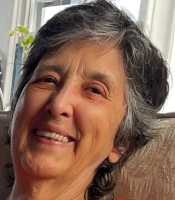 Marie T. Russell is the founder of InnerSelf Magazine (founded 1985). She also produced and hosted a weekly South Florida radio broadcast, Inner Power, from 1992-1995 which focused on themes such as self-esteem, personal empowerment, and well-being. Her articles focus on transformation and reconnecting with our own inner source of joy and creativity.
Creative Commons 3.0: This article is licensed under a Creative Commons Attribution-Share Alike 4.0 License. Attribute the author: Marie T. Russell, InnerSelf.com. Link back to the article: This article originally appeared on InnerSelf.com
Related Books:
-
All About Love: New Visions
In this thought-provoking book, bell hooks challenges us to see love as something we actively practice rather than simply a feeling we experience. She examines how compassion, honesty, caring, and responsibility can transform our relationships and help heal a society divided by fear and indifference. Her vision of love extends far beyond romance to embrace our connections with everyone around us.
Amazon: https://www.amazon.com/exec/obidos/ASIN/006346313X/innerselfcom
-
The Art of Loving
Erich Fromm presents love not as something that simply happens to us, but as an art that requires awareness, practice, and a willingness to grow. He examines the importance of self-love, compassion, responsibility, and genuine concern for others. His insights encourage us to move beyond fear and dependency toward a more conscious and generous expression of love.
Amazon: https://www.amazon.com/exec/obidos/ASIN/0061129739/innerselfcom
-
The Book of Joy: Lasting Happiness in a Changing World
Through heartfelt conversations filled with wisdom and humor, the Dalai Lama and Archbishop Desmond Tutu examine how compassion, kindness, and human connection can bring joy even during difficult times. Drawing on their personal experiences of suffering and resilience, they remind us that caring for others can also nourish our own happiness. Their message offers an uplifting perspective on the power of love to heal both individuals and communities.
Amazon: https://www.amazon.com/exec/obidos/ASIN/0399185046/innerselfcom
Article Recap:
Choosing love over fear can transform ordinary encounters into meaningful moments of healing and human connection. Through a touching experience with a grieving stranger, Marie T. Russell reminds us that acts of kindness, compassion, and following our inner guidance can make a difference far beyond what we realize. When we open our hearts and share love freely, we help heal not only ourselves and others, but also our world.
#ChoosingLove #PowerOfLove #LoveOverFear #ActsOfKindness #Compassion
#HealingThroughLove #HumanConnection #FollowYourHeart #InnerGuidance #SelfLove
#PersonalEmpowerment #EmotionalHealing #SpreadLove #InnerPeace #InnerSelf #innerselfcom