In This Article
- Why every political decision carries an economic price tag that gets paid later
- How first-, second-, and third-order consequences explain why good intentions produce bad outcomes
- What gun violence, tariffs, immigration policy, and climate change all have in common economically
- Why public trust is one of the most valuable and least appreciated economic assets a society holds
- How systems thinking separates good governance from expensive theater
There is a business owner in every town who makes the same mistake. He cuts corners on equipment because the savings show up immediately and the consequences show up later. He skips the maintenance because the breakdown hasn't happened yet. He lets good employees walk because replacing them seems cheaper than keeping them. Every one of those decisions makes perfect sense in the moment and becomes a disaster in the rearview mirror. The strange thing is that we recognize this pattern instantly when we see it in business. We nod knowingly. We say he didn't think it through. Then we go vote for politicians who do the exact same thing at a scale that affects millions of people, and we call it governing.
The Question Nobody Asks Before Passing the Law
There is a deceptively simple question that separates competent management from expensive wishful thinking. It is not a complicated question. Engineers ask it before they design a bridge. Doctors ask it before they prescribe a medication. Good chess players ask it before they move a piece. The question is simply this: and then what happens?
Politicians are rarely rewarded for asking it. Campaigns run on first-order effects, which are the immediate visible results of a policy. Tariffs protect domestic industry. That is the first-order effect and it fits on a bumper sticker. What fits less neatly on a bumper sticker is what happens next. Imported components become more expensive. Manufacturers who depend on those components lose their competitive edge. Consumers pay higher prices at the store. Inflation ticks upward. Trading partners retaliate with their own tariffs. Farmers who export their crops suddenly find their markets closing. Investment slows because businesses hate uncertainty more than they hate almost anything else. That chain of consequences is the second- and third-order reality that the economy actually lives in, while the political debate stays frozen at the first step.
This is not a liberal critique of conservative economics or a conservative critique of liberal spending. This is an observation about how complex systems work. Economies are not simple machines with one lever. They are ecosystems with millions of interconnected parts, and when you pull hard on one strand, the whole web moves in ways that are genuinely difficult to predict unless you are in the habit of asking the question nobody asks.
Confidence Is the Invisible Engine of Every Economy
Here is something economists know but rarely say plainly enough. People do not spend money simply because they have money. People spend money because they feel confident about what tomorrow looks like. When confidence is high, ordinary people do extraordinary economic things. They start businesses. They hire employees. They buy houses. They take vacations. They go to concerts and restaurants and sporting events and downtown shops. They have children and enroll them in schools and invest in communities they believe will still be standing in twenty years.
When confidence disappears, all of that quietly stops. Not dramatically. Not all at once. It bleeds away the way a slow leak empties a tire. The restaurant that used to be full on a Friday night starts turning fewer tables. The contractor who used to have a six-month backlog starts watching his phone. The young couple that was saving for a house decides to wait another year and see. None of these individual decisions make headlines. Together they become a recession, a stagnant decade, a city that used to be something.
Every political decision either builds confidence or erodes it. That is not a metaphor. It is a mechanism. Politics shapes the environment in which billions of ordinary people make billions of ordinary decisions every day. Change the environment and you change the decisions. Change enough decisions and you change the economy. The connection between the political choice and the economic outcome is real, it is measurable, and it is almost never part of the political debate that produced the choice in the first place.

What a Concert Cancellation Tells You About Gun Violence
Let us stay out of the constitutional debate entirely, because the economic argument stands completely on its own. When people feel unsafe in public spaces, they stop using public spaces. That is not ideology. That is human behavior that shows up reliably in the data every time it is studied.
After high-profile shootings in public venues, researchers consistently document measurable drops in foot traffic at nearby businesses. Convention bookings fall. Tourism revenue declines. Cities that develop reputations for public violence watch businesses quietly choose different cities for expansions, relocations, and new headquarters. Insurance premiums for public events rise. Security costs rise. Legal exposure rises. All of those costs eventually land somewhere, and where they land is on the prices consumers pay and the wages workers receive and the tax base that funds schools and roads and the other things that make a place worth living in.
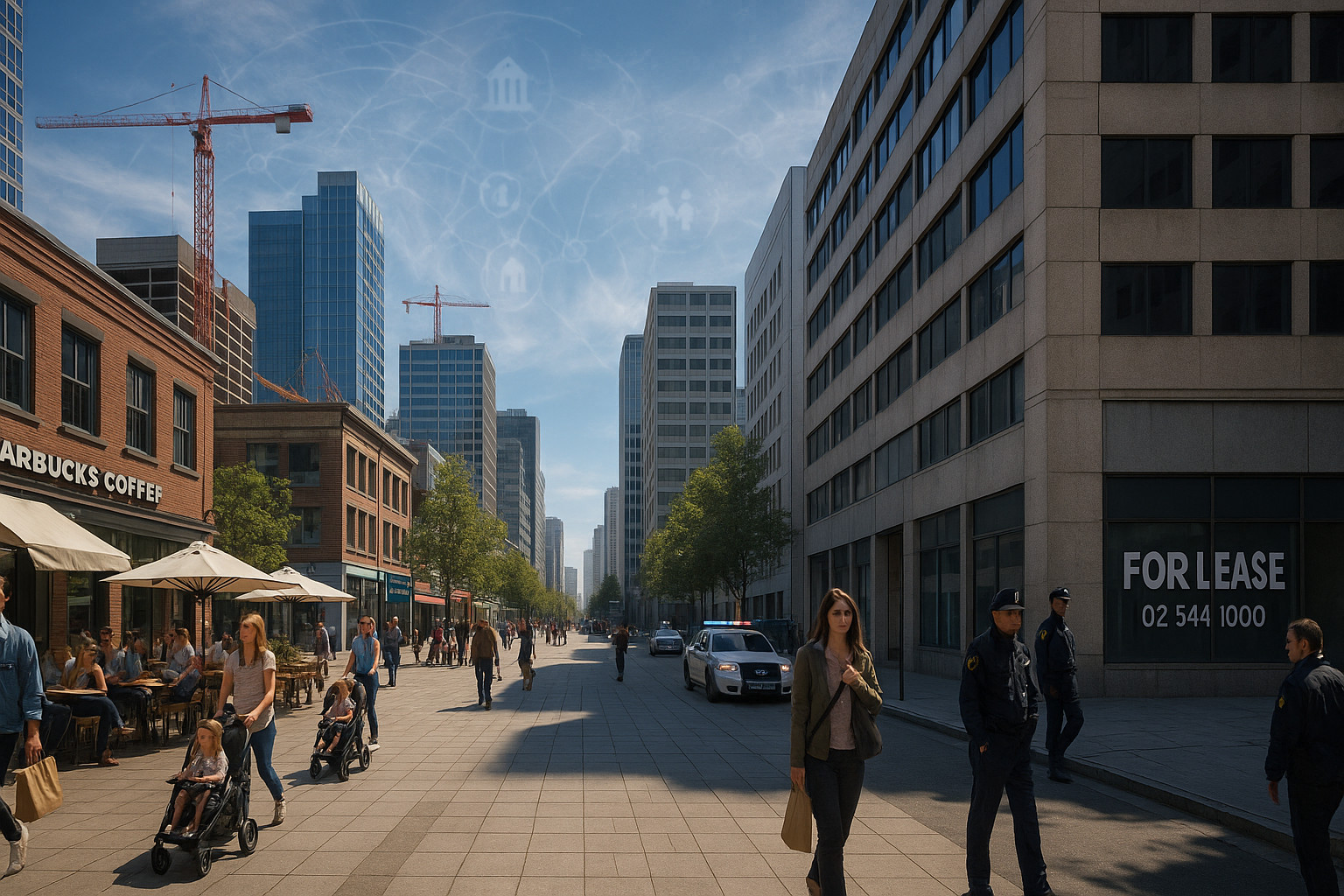
The people who leave a downtown area because it feels unsafe are not making a political statement. They are making an economic decision. Multiplied by enough people over enough years, that decision reshapes a city's finances as surely as any budget vote ever did. The political argument about guns rarely includes that balance sheet. It probably should.
The Labor Market Doesn't Care About the Slogan
Immigration is one of the most emotionally charged debates in any democratic country, and the emotional charge tends to crowd out a straightforward economic observation. Labor markets are supply and demand systems. When labor supply drops sharply in specific sectors, costs in those sectors rise and output in those sectors falls. That is not a political position. It is arithmetic.
Construction costs rise when there are not enough workers to frame houses. Food prices rise when there are not enough workers to harvest crops. The housing shortage that has made homeownership impossible for an entire generation of younger Americans has multiple causes, and one of them is that building enough housing requires workers and the workforce in residential construction has contracted. The family that cannot afford a starter home is experiencing the third-order consequence of a labor policy debate that never mentioned them.
There is also a less-discussed side of the ledger. Immigrants start businesses at higher rates than native-born Americans in nearly every country where the data has been gathered. Those businesses hire workers. They generate tax revenue. They create the neighborhood restaurants and corner stores and small manufacturers that become the economic texture of a community. The policy question of how to manage borders is genuinely complicated and reasonable people hold different views. The economic reality of what labor markets do when supply is restricted is not complicated at all. Pretending otherwise is not a political choice. It is an expensive one.
Every Disaster Is a Tax on Future Prosperity
The climate debate gets mired almost immediately in questions about science, which is unfortunate because the economic questions do not require anyone to settle the science. They only require looking at what is already happening to insurance markets, infrastructure budgets, property values, and municipal finances in areas experiencing more frequent and more severe weather events.
Insurance companies do not make political decisions. They make actuarial decisions based on risk models, and those risk models have been dramatically repriced over the past decade in coastal areas, wildland-urban interfaces, flood plains, and drought-prone agricultural regions. When private insurers exit a market, state insurers of last resort absorb the risk and taxpayers absorb the cost. When infrastructure is repeatedly damaged and repeatedly rebuilt, those reconstruction budgets come from somewhere. When a business decides where to locate a new facility, the reliability and cost of utilities, the flood risk of the site, and the insurance premium on the building are all line items in the financial model. Climate-related costs are already present in the economy. The political argument is mostly about whether to acknowledge them.
A disaster is not a one-time expense. It is a deduction from future prosperity because the money spent on recovery is money not spent on schools, research, infrastructure improvements, or any of the other investments that compound over time into economic strength. Every political decision that increases the probability or severity of future disasters is making a financial commitment that will come due whether or not the political coalition that made it is still in office.
The Economic Value of Knowing Things
There was a period in American history when the federal government made a series of large, deliberate investments in human capital and physical infrastructure. The GI Bill sent a generation of veterans to college and helped them buy homes, creating the consumer middle class that drove the most sustained economic expansion in the country's history. The Interstate Highway System connected markets, reduced transportation costs, enabled supply chains, and made the American economy more productive in ways that are still generating returns today. The postwar investment in scientific research and universities produced the technologies that every economy in the world now depends on.
These were not acts of charity. They were investments with enormous returns, and the returns came because knowledge and infrastructure are not consumed when they are used. They compound. A researcher whose education was publicly supported may produce an innovation that generates private wealth for decades. A highway built in 1960 is still moving goods in 2024. When a society underinvests in education, research, and the preparation of its workforce, it does not simply fail to gain those returns. It begins importing innovation and talent from societies that made the investment instead.
The political debate about education funding is almost always framed as a spending debate. It is actually an investment debate, and the return on investment in human capital is among the most thoroughly documented findings in all of economics. Countries that treat education as an expense tend to pay for that decision in reduced competitiveness one generation later, which is precisely the timeline that makes the political connection so easy to miss.
Trust Is Worth More Than Anyone Budgets For
There is an economic concept called transaction costs, and it refers to all the friction involved in making a deal happen. Legal fees. Verification costs. The time spent confirming that the other party will do what they say. In economies where institutional trust is high, transaction costs are low. People sign contracts and expect them to be honored. They accept payment in currency they trust. They invest in businesses operating under rules they believe will remain predictable. Commerce moves quickly and cheaply because the underlying infrastructure of trust makes it possible.
When trust in institutions erodes, every transaction gets more expensive. Businesses require more legal protection before they will invest. Foreign capital looks for more stable environments. Citizens who do not trust their courts or their elections or their regulatory agencies behave accordingly, which means they hedge, they hoard, they delay, they choose not to participate in economic activities that require confidence in institutions they no longer have confidence in. The economic cost of institutional distrust is enormous and almost entirely invisible in political accounting.
Democracies generate trust slowly and spend it quickly. Political actors who undermine confidence in elections, courts, or the basic machinery of governance for short-term advantage are making a withdrawal from an account that took generations to fill. The balance sheet of that transaction rarely appears in any campaign document. It appears later, in investment decisions, in business location choices, in the quiet accumulation of economic hesitation that eventually becomes visible as stagnation.
Engineering the Future Instead of Winning the Moment
Engineers are not permitted to be optimistic about structural failure. When a civil engineer designs a bridge, she is required to model what happens when the load exceeds the design spec, when a support degrades, when the unexpected occurs. The question is not whether anything will go wrong. The question is what happens when something goes wrong and whether the system can absorb it. That discipline, the professional obligation to model failure before it happens, is what keeps bridges standing for a century.
Good governance requires exactly that discipline and gets it far less often. The political incentive structure rewards the announcement of a policy and rarely holds anyone accountable for the downstream effects that appear after the next election cycle. A tariff that protects jobs in one sector while raising costs in three others produces political winners and economic losers on a timeline that almost never lines up with the news cycle that covered the original announcement. A budget cut that saves money today and reduces capacity tomorrow generates applause at the press conference and consequences in the quarterly report nobody holds five years later.
The way out of this pattern is not a different ideology. It is a different habit of mind. Societies that learn to evaluate policies by their second- and third-order consequences, that build institutions capable of tracking those consequences honestly, and that hold political actors accountable for outcomes rather than intentions, those societies tend to make fewer expensive mistakes. They tend to build the kind of durable prosperity that outlasts the politicians who happened to be in office when it was created.
About the Author
 Robert Jennings is the co-publisher of InnerSelf.com, a platform dedicated to empowering individuals and fostering a more connected, equitable world. A veteran of the U.S. Marine Corps and the U.S. Army, Robert draws on diverse life experience, from real estate and construction to building InnerSelf.com with his wife, Marie T. Russell, bringing a practical, grounded perspective to life's challenges. InnerSelf grew from InnerSelf Magazine, founded by Marie T. Russell in 1985, which became InnerSelf.com in 1996. Decades later, InnerSelf continues to inspire clarity and empowerment.
This article is licensed under a Creative Commons Attribution-NonCommercial-NoDerivatives 4.0 License. You may share it with attribution to Robert Jennings, InnerSelf.com, and a link back to the original article at InnerSelf.com. Commercial use and derivative works are not permitted without permission.
Recommended Books
Thinking in Systems: A Primer by Donella H. Meadows — A clear and accessible introduction to systems thinking that explains how complex systems produce unintended consequences, perfect for understanding why political decisions have ripple effects that extend far beyond their original intent.
The Wealth of Nations by Adam Smith — The foundational text on how economies actually function as interconnected systems of human decisions, incentives, and consequences rather than as simple mechanisms controlled by any single authority.
Why Nations Fail: The Origins of Power, Prosperity, and Poverty by Daron Acemoglu and James A. Robinson — A landmark examination of how political institutions shape economic outcomes over generations, demonstrating through historical evidence that the quality of governance determines whether societies prosper or decline.
Article Recap
Understanding the second- and third-order economic consequences of political decisions is one of the most important and least practiced skills in democratic life. When voters and policymakers learn to ask what happens next, they begin to see that every political choice either builds or erodes the confidence, trust, stability, and institutional integrity that economic prosperity depends on. The long-term economic cost of short-term political thinking is always real, always arrives eventually, and is almost always larger than anyone budgeted for.
#UnintendedConsequences #EconomicConsequences #PoliticsAndEconomy #SystemsThinking #PublicPolicy #EconomicConfidence #PolicyImpact #GovernanceMatters #SecondOrderThinking #InnerSelf