








In This Article
- Record public frustration with government corruption and the persistent underrepresentation of women in Congress
- Research on empathy and honesty that has practical implications for lawmaking
- Evidence from real elections in Brazil and 76 countries linking women's representation to lower corruption
- A Swedish study showing that gender-balanced candidate lists improved the quality of male politicians too
- Why sharing power in practice means sharing committee chairs, hearing agendas, and the authority to investigate
In Sept 2026 Gallup reported that 89% of Americans said corruption was rife in government. That was a record high. It wasn't a partisan result. It was a result that was reported by Democrats, Republicans and Independents in equal measure. Nearly everyone who answered the question said the people in charge were doing something wrong.
And yet the institution that those people run looks pretty much the same as it has for decades. Women are 29% of the House and 25% of the Senate (taking into account both the newly elected and those whose seats have carried over from previous elections). That's not half. That's not even close to half.
If Americans are truly fed up with the way Washington works then the obvious question is why are we still so comfortable with one gender having the vast majority of the seats, the vast majority of the committee chairs and the vast majority of the decisions?
What Empathy Looks Like in a Congressional Hearing Room
Empathy isn't a word you hear very often in the course of a debate in Congress. It probably ought to be. A study across 57 countries found that women on average scored higher than men on a validated test of reading what other people were thinking or feeling from the look in their eyes. That's not some stereotypical thing or some sentiment you'd find on a greeting card. It's a genuine cognitive ability, the capacity to pick up on what another person is experiencing without them having to spell it out.
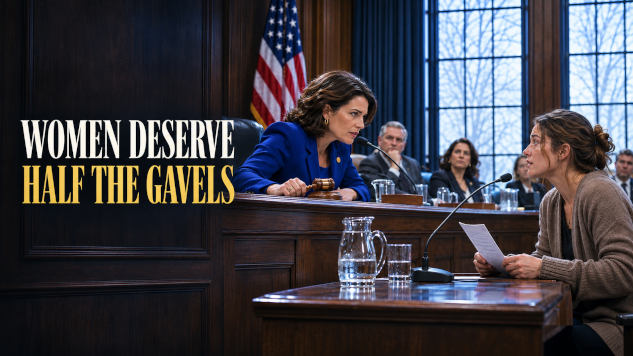
Take that into a congressional hearing room. A witness is attempting to explain how a proposed policy change will impact her family. She's not a professional lobbyist. She doesn't have a set of talking points prepared by a law firm. She's nervous and she's not saying exactly what she means. Who notices? Who asks the follow-up question?
Who actually leans in rather than just checking the time? That ability to read a room is critical when you're writing laws that are going to impact people's everyday lives. You can have all the data in the world but if you can't read a room you're going to miss the important stuff. The kind of stuff that years down the line becomes a consequence that nobody in the room at the time ever thought to ask about.
Honesty Under Pressure Is Not a Small Detail
A set of controlled experiments published via Cambridge University Press found that men were more likely to lie for their own gain at the expense of someone else. These were not political situations. They were the kind of laboratory scenarios where you could actually measure the individual's choice and the cost of that choice. The pattern was consistent.
Now apply that to Congress. What happens when the truth is simply too costly to tell? What happens when a committee chair knows that the release of certain findings will embarrass a donor, a colleague or a party leader? Every member is going to be in a position at some point where the truth is simply not in their interests. The question is not whether some member of Congress will ever be tempted to slightly soften the truth.

The issue is whether the make-up of the body itself tips the balance. If one group are demonstrably more willing to lie when it suits them personally and that group has three quarters of the seats, we shouldn't be surprised by the outcome. We've been watching the outcome for years.
What Happened When Women Won Close Elections in Brazil
The lab findings are useful, but elections are better. A study of Brazilian mayoral races (where a woman just edged out a man or a man just edged out a woman) was carried out. The races were so close that the outcome was essentially random, which allowed the researchers to isolate the effect of the gender of the mayor from all other factors. They then went on to look at the results of random government audits in those same municipalities.
The finding was pretty simple. The municipalities led by women who had just narrowly won showed less corruption in the audits. Not zero corruption. Less. They were in exactly the same political system, facing exactly the same pressures, managing exactly the same budgets. The only difference was who was in charge.
That's not a lab. That's governance. It's real money, real audits and real consequences for the ordinary folk who actually rely on public services getting to them rather than just vanishing into someone's pocket.
The Pattern Holds Across 76 Countries
A wider study looked at the link between women's representation and corruption across 76 countries and found the same thing as the Brazilian study. More women in elected office was associated with lower levels of corruption and the effect was most pronounced in those countries where voters actually had mechanisms to hold their elected representatives to account.
That second bit is important. Representation on its own is not magic. It works best when it is coupled with accountability, when the electorate can actually see what their representatives are doing and can hold them to account. Women's representation and democratic accountability go hand in hand. More women in office leads to less corruption and that effect is magnified when there is both transparency and electoral competition. This is not an argument for tokenism. This is an argument for structural change which has real world consequences.
Yes, It Could Make Some of the Men Behave Better
This is the bit that tends to unsettle people, so let me just say it straight. Having more women in Congress might actually improve the quality of the men in Congress.
Researchers in Sweden looked at what happened when the Social Democrats began to alternate men and women on the local candidate lists. As the number of women in the lists increased, the researchers' measure of the competence of male politicians went up. The increase was most pronounced in the areas where the number of women on the lists increased most. On further analysis they found the departure of the less competent male politicians to be a key factor. It was the men who weren't good enough to be there on merit who were the ones who lost their seats.
Think about that for a moment. For years some men had held on to office not because they were particularly good at it but because the field was so narrowly defined that there was no real competition. When the field was opened up, the dead wood got cleared away and what remained were on the whole better at the job. That's not an insult to men in politics at all. That's a compliment to competition.
Bring it home to Congress. The sharing of power changes who can protect an incumbent, who can bury a hearing and who gets to decide which questions are going to be asked. If you have a committee that's been running for years on the basis of people owing each other favors and covering each other's backs, certain investigations simply don't happen. Certain questions simply don't get asked. Certain witnesses simply don't get called. Change the room and you change the dynamics. Some of the men will behave very differently if they have fewer colleagues who are going to be there to cover their backs.
What Sharing Power Actually Looks Like
People talk about representation as if it's all about images. A woman on a poster. A diverse group photo for the website. That's not what I'm talking about. I'm talking about power. I'm talking about real, tangible, operational, day to day power.
Who chairs the committees? The chair determines what gets looked at and what gets ignored. The chair decides who gives evidence and who doesn't. The chair sets the schedule, the agenda and the staff. In Congress the committee chair has absolutely massive power over what becomes law and what just dies in a drawer.
Who controls the floor agenda? Who decides whether a bill gets a vote or languishes in legislative purgatory until everyone has forgotten about it? Who is the one who insists an investigation goes ahead when the powerful would much prefer it simply to vanish? That is what sharing power looks like in practice. It's not about putting a few more women in the backbench where they can vote but not actually steer. It's about women holding half the gavels.
Right now that's not happening at all. Not in committee leadership, not in party leadership and not in the informal world where the deals get done and the favors get exchanged. The structure of Congress is still very much a male dominated one at the level where the power actually lies. And we're not surprised by the way the institution works.
The People Already in Charge Should Have to Explain Themselves
I keep returning to that Gallup figure (89%). Nearly nine in ten Americans look at their government and see it as corrupt. That's not some marginal view. That's the view of the country as a whole. The people who did that survey, the people who have been in the saddle for years, the people who have been in the chair, who have set the agenda and decided what gets looked at, are almost entirely from one side of the house.
Women are half this country. I want them in half the seats, chairing committees and asking the questions that the people in power would much rather not ask. I want them in the room when the budgets are being drawn up, when the witnesses are giving evidence and when someone has to make a decision as to whether or not to go ahead with an investigation which might well embarrass a colleague.
The research shows they are on average more empathetic, more honest and linked with less corruption in actual practice. The Swedish evidence shows that their presence actually improves the quality of the men who are around them.
None of this means that every woman in office will be a saint. Politics has a way of wearing down anyone who gets in the machine. The evidence is clear though, across the board in different countries and contexts. More women in power leads to better governance. We have a Congress that pretty much everyone agrees is a failing one. We have a body of research which points to a structural change that has tangible benefits. And we have a country where women are still massively under-represented in the institution which is the one that writes the laws they live by.
When nearly nine in ten Americans see widespread corruption the people who have been running the country ought to be able to explain why we should be continuing to give them so much power. I haven't heard a very convincing answer to that yet. I don't think I will.
Recommended Books
The Authority Gap by Mary Ann Sieghart — A deeply researched examination of why women are still taken less seriously than men in public life and what that costs everyone.
Corruption in America by Zephyr Teachout — A historical account of how corruption has been understood, tolerated, and fought from the founding era to the present day.
Good and Mad by Rebecca Traister — An exploration of how women's anger has been a transformative political force in American history, often producing the reforms that institutions refused to undertake on their own.
Article Recap
Research across multiple countries shows that greater women's representation in government is linked to lower corruption, greater empathy in policymaking, and improved quality of male politicians. With 89 percent of Americans seeing widespread corruption in government, the case for women holding half the seats in Congress is supported by evidence from elections, laboratory studies, and cross-national comparisons. Achieving gender balance in legislative power is not simply a matter of fairness but a practical strategy for reducing corruption and improving governance.
#WomenInCongress #GenderEquality #PoliticalCorruption #WomenInPolitics #RepresentationMatters #GenderParity #GovernmentAccountability #EqualRepresentation #WomenLeadership #DemocracyReform