

Many people believe that changing jobs, partners, or locations will resolve their unhappiness. However, true change starts from within. By shifting one's mindset and understanding personal reactions, individuals can find fulfillment and inner peace, regardless of external circumstances. Doug's journey illustrates the importance of internal transformation over external solutions.
In This Article
- What drives the desire for external change?
- How does mindset influence perception and behavior?
- What methods can facilitate internal change?
- How can individuals apply new perspectives in daily life?
- What are the potential risks of seeking external solutions?
When we are unhappy, we often quite naturally begin to fantasize about how our troubles would end "if only". If only I could move to the country and avoid the hassle of city life... If only I could quit my job and do something simpler, like be a forest ranger in a national park... If only I could leave this marriage, which isn't working out, and find someone who really understands me...
Unfortunately, all too often we quit that stressful job or leave that unhappy marriage, only to find ourselves in a similar or worse situation. Why is this?
Looking for external solutions to our psychological problems doesn't work. In other words, if we don't change our thinking, we will bring that thinking right along with us to the next job or the next marriage or the new house in the country. Our experience of life is the creation of our own thinking > perception > emotion > behavior. This doesn't mean that people should never change jobs or careers, move to a better location, or even find a new significant other. It simply means that nothing changes on the outside if nothing changes on the inside, where your experience is created -- your mind.
Looking for a Better Life
Doug came to me for help with several problems. He was stressed beyond his limit. He was unable to sleep at night, hated the industry he was in and the people he worked with, had angry outbursts at work, and couldn't maintain a significant relationship. To Doug, it appeared that he was in the wrong job and living in the wrong state and that his problems were all a result of those factors. In the past ten years he'd taken five new jobs, moved to four new homes, and failed in numerous relationships.
Doug would often fantasize about moving to Colorado, getting a job at a ski resort, and simplifying his hectic life. He was making great money where he was, but the stress wasn't worth it to him, and he knew he wasn't getting any younger. He sought me out because he wanted to make sure he wasn't going to regret his decision later.
"Everybody around here is always pushing my buttons", Doug said. "They have no respect for my time, my priorities, or my responsibilities, yet they want me to respect theirs. Well, I tell you, they can take this job and do you know what with it!"

This was Doug's typical complaint. But as he began to understand the principles described in this book (The Speed Trap), his view of his job and other people gradually began to change.
The Fork in the Road
One day, Doug realized he'd had it with his supervisor. One more demand like that and I'll show him. I'll quit, Doug grumbled to himself.
Sure enough, his supervisor asked him to cancel his other plans and fly to Florida the next day; this was an emergency.
"I'm sick and tired of your demands! What do you take me for -- a fool?"
With that, Doug stormed out of his supervisor's office and out to the parking lot. He sped out of the driveway, and within two blocks a police officer pulled him over and began writing out a ticket for going 50 in a 35-MPH zone.
As Doug sat in his car, it dawned on him that he was totally out of control and definitely in an unhealthy way of thinking. Once again, he had made an impulsive, reactive decision while in a rage. All of his musings about leaving the job seemed to build up to this point. What have I done? he asked himself. Is this really what I want, or am I overreacting? Suddenly, it became absolutely clear to him that he had been "temporarily insane" and had acted on that insane thinking.
When the officer handed him the ticket, Doug thanked him for the wake-up call. Puzzled, the officer walked away wondering why anyone would be thanking him for a ticket.
Doug suddenly realized that this was just one of numerous occasions in which he had set himself up for having a major emotional reaction by thinking that "they" were ruining his life. It became clear to him that he was taking everything personally and that it was his thinking that was giving him his emotional reaction.
A flood of memories and insights washed over him, and he saw this pattern throughout his whole life, with his family, his bosses, his girlfriends, other jobs. It was always "their fault", and his only recourse was to get away from those negative influences. That had appeared to be his only option this time once again -- up to the moment he got the speeding ticket.
A Fresh Start with a New Attitude
Doug went back to the office and apologized to his boss.
"I'm really sorry I reacted to you the way I did. I was way out of line. I'll be in Florida tomorrow."
With that accomplished, Doug actually began to feel good about the trip and even decided to throw in his golf dubs and take the weekend off for some R & R. Man, I'm so lucky to have a job that will get me out of the cold winter and off to Florida, he thought, as he went whistling out the door.
On the plane back from Florida, Doug felt a warm glow of grateful feelings as he realized how much he actually loved his job, especially now that he realized where the power over his anger and his happiness truly resided. Boy, am I glad I didn't quit. That was a close one. I wonder in how many other areas of my life I've been doing the same thing, Doug mused. I guess the grass only looked greener because I needed a new pair of glasses!
Reprinted with permission of the publisher,
HarperSanFrancisco, an imprint of
Harper Collins, Inc. ©1999.
Article Source:
The Speed Trap: How to Avoid the Frenzy of the Fast Lane
by Joseph Bailey.
B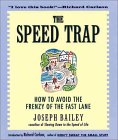 etween work, play, family, and friends, most of us feel like we're speeding along at 100 miles an hour. Our lives are full, yet we don't feel fulfilled. One solution is to slam on the brakes and adopt a radically simpler lifestyle. But, as psychologist Joe Bailey demonstrates in this essential guide, you don't have to give up everything to slow down your life. In over thirty-five captivating, instructive stories, you'll discover how to: Enjoy each moment and stop worrying about the past or the future; Gain insight by trusting your instincts; Increase your productivity and achieve success-without stress; Disregard the negative emotions of people around you; and Attain a deep-rooted sense of fulfillment and inner contentment
Click here for more info and/or to order this paperback book. Also available in a Kindle edition.
About The Author

Joseph Bailey is the president of the Minneapolis Institute of Mental Health and Health Realization Consultants in Minnesota. He has trained chemical dependency counselors from around the world for the Johnson Institute in Minneapolis. He is the author of The Speed Trap as well as of Serenity Principle, Slowing Down to the Speed of Life and Slowing Down to the Speed of Love.
Further Reading
-
The Happiness Trap: How to Stop Struggling and Start Living
This book introduces practical techniques from Acceptance and Commitment Therapy to help people stop being controlled by unhelpful thoughts and emotional reactions. It emphasizes that lasting change comes from changing one's relationship with thoughts rather than constantly trying to change external circumstances.
Amazon: https://www.amazon.com/exec/obidos/ASIN/1590305841/innerselfcom
-
The Four Agreements: A Practical Guide to Personal Freedom
This modern spiritual classic explores how our assumptions, beliefs, and habitual reactions create much of our personal suffering. By taking responsibility for our own thinking and behavior, we become less likely to blame other people or changing circumstances for our unhappiness.
Amazon: https://www.amazon.com/exec/obidos/ASIN/1878424319/innerselfcom
-
The Speed Trap: How to Avoid the Frenzy of the Fast Lane
This book expands on the principles illustrated in the article, showing how stress, impulsive thinking, and emotional reactions distort our perception of reality. Through real-life stories and practical insights, it demonstrates how greater awareness can transform relationships, work, and everyday decision-making.
Amazon: https://www.amazon.com/exec/obidos/ASIN/0062515896/innerselfcom
Article Recap
Real change stems from within, emphasizing the importance of mindset over external factors. Individuals should reflect on their thought patterns to achieve true fulfillment.
#InnerSelfcom #MindsetShift #PersonalGrowth #EmotionalIntelligence #SelfAwareness #Fulfillment