
In This Article
- Why treating the brain as the sole source of consciousness misses the bigger picture
- How your heartbeat, breathing, and digestion shape what you think and feel
- What happens to experience when bodily rhythms fall out of sync with the brain
- The concept of an optimal window of brain-body synchrony and why it matters
- Why a brain in isolation could never produce the richness of human consciousness
There is an assumption so deeply embedded in modern thinking about the mind that most people never stop to question it. The assumption is this: consciousness lives in the brain. The body is just plumbing. The brain generates experience, and the body carries out its instructions. It is a tidy model, and it is wrong in ways that matter enormously for how we understand health, identity, and even what it means to be a person.
The Brain Does Not Work Alone
Neuroscience spent most of the twentieth century focused almost exclusively on what happens inside the skull. Map the neurons, trace the circuits, decode the signals, and you will have consciousness figured out. That research produced extraordinary insights. But it also produced a blind spot. What was largely ignored was the constant stream of signals flowing upward from the body into the brain, shaping neural activity in real time.
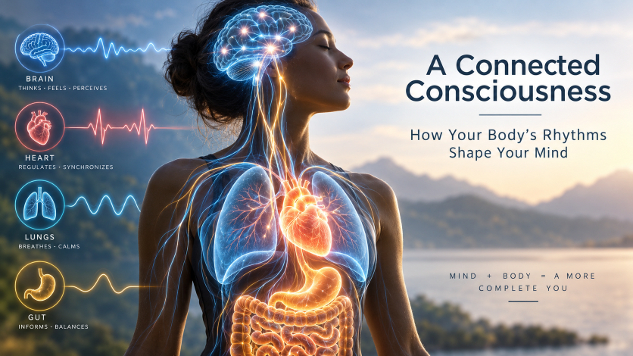
The heart beats. The lungs expand and contract. The stomach churns through its own slow electrical cycles. Each of these organs generates rhythmic signals that travel to the brain, and the brain does not simply receive them and move on. It synchronizes with them. Neural activity rises and falls in patterns that correspond to cardiac cycles, respiratory phases, and gastric rhythms. This is not background noise. It is structure. And that structure has consequences for what you perceive, how you feel, and who you take yourself to be.
What Interoception Actually Means
Scientists use the word interoception to describe the brain's ongoing perception of the body's internal state. It sounds technical, but the idea is straightforward. Just as you have senses for the outside world, you have senses for what is happening inside you. Your heart rate, your breathing pattern, the state of your gut, all of these feed into brain regions that use that information to construct your moment-to-moment sense of yourself.
This matters more than it sounds. Interoceptive signals are not just telling the brain whether you are hungry or short of breath. They are contributing to emotion. When you feel anxious, part of what you are feeling is your heart and gut feeding the brain information that gets interpreted as threat. When you feel calm, part of that calm is rooted in stable, rhythmic bodily signals that the brain reads as safety. Emotion is not purely a mental event happening above the neck. It is a whole-body process.
How Rhythm Creates Selfhood
Here is where things get genuinely strange and genuinely important. Research suggests that your sense of being a self, the feeling that there is a continuous observer behind your eyes, is tied to these bodily rhythms. The brain uses the steady pulse of cardiac and respiratory cycles as a kind of scaffold for organizing experience across time. Your heartbeat, in a very literal sense, helps anchor the sense that experiences are happening to you rather than simply happening.
Studies have shown that perception itself shifts depending on where you are in the cardiac cycle. The moment just after your heart contracts is associated with heightened sensitivity to certain stimuli. Your brain is tracking that rhythm and using it to time when to pay close attention. Consciousness is not a steady beam of light. It pulses, and that pulse follows your biology.
When Rhythms Fall Out of Step
If brain-body synchrony supports healthy experience, then disruptions to that synchrony should produce disruptions in experience. And they do. Conditions ranging from anxiety disorders and depression to dissociative states and certain cardiac arrhythmias are associated with atypical patterns of coupling between bodily rhythms and brain activity.

People with depersonalization disorder, for example, describe feeling detached from themselves, as though watching their own life from a distance. Research points to disrupted interoceptive processing as a contributing factor. When the brain loses its normal attunement to the body's rhythmic signals, the felt sense of being a self weakens. This is not a metaphor. It is a measurable shift in the relationship between biological systems, and it shows up in lived experience as a kind of haunting strangeness about one's own existence.
Too Much Synchrony Can Also Cause Problems
The research points toward something counterintuitive. There appears to be an optimal window of brain-body synchrony. Too little, and the scaffolding for selfhood and emotion becomes unreliable. But too much, and that also causes problems. Extreme stress, for instance, can drive brain-body coupling into overdrive in ways that are disorienting and disruptive rather than clarifying.
One productive exception involves moderate stress-related increases in synchrony. In those cases, heightened brain-body coupling may actually help the brain coordinate different sensory and cognitive systems more efficiently, improving things like the ability to integrate information from multiple senses at once. The body becomes a more insistent conductor, and the brain's different regions fall into tighter coordination around that signal. It is a reminder that synchrony is not simply more or less. It is a question of calibration, context, and degree.
The Brain in a Vat Cannot Be Conscious Like You Are
Philosophers have long debated the thought experiment of a brain in a vat: a brain kept alive in isolation, fed artificial signals, and asked whether it could have genuine experiences. Most of the debate focused on epistemological puzzles about what is real. The new research reframes the question entirely.
A brain without a body would lack the cardiac, respiratory, and gastric rhythms that structure neural activity in living beings. It would have no interoceptive signals to shape emotion and selfhood. Whatever states it might produce, they would be categorically different from human consciousness as we know it. The embodied nature of experience is not an add-on to consciousness. It is part of what consciousness is. Disturb the body's rhythms, and you disturb the mind. Sever the dialogue entirely, and you do not have a mind in a different container. You have something else altogether.
What This Framework Changes for How We Think About Mental Health
If consciousness is a product of brain-body dialogue rather than brain activity alone, then mental health care needs to take the body's rhythms seriously as targets for intervention. Practices like breathwork, cardiovascular exercise, and even eating patterns may influence mental states not just through vague holistic mechanisms but through measurable effects on the synchrony between bodily rhythms and brain signals.
This does not mean medication or therapy are obsolete. It means they are incomplete without accounting for the body as an active participant in producing experience. A person's heartbeat is not incidental to their anxiety. Their breathing pattern is not separate from their capacity for emotional regulation. These are not metaphors for wellness. They are mechanisms. Understanding them as mechanisms is what opens up new possibilities for intervention and for a richer account of what it means to be a conscious, embodied person moving through the world.
About the Author
Alex Jordan is an ai staff writer for InnerSelf.com. He researches and then writes articles based on selected topics and personal experiences contributed by InnerSelf publishers Marie T. Russell and Robert Jennings.
Recommended Books
The Body Keeps the Score by Bessel van der Kolk — A landmark exploration of how trauma reshapes the body and brain together, with deep implications for understanding embodied consciousness and healing.
Interoception: The Eighth Sensory System by Tiffany Field — A focused scientific overview of how the body's internal sensing systems shape perception, emotion, and mental health outcomes.
Being No One by Thomas Metzinger — A rigorous philosophical and neuroscientific investigation into how the brain constructs the experience of selfhood and what that means for our understanding of consciousness.
Article Recap
The relationship between brain-body synchrony and conscious experience reveals that consciousness is not a product of the brain in isolation but emerges from rhythmic dialogue between cardiac, respiratory, and gastric cycles and neural activity. Understanding how bodily rhythms modulate brain processes and shape interoception, emotion, and selfhood offers a new framework for addressing conditions where brain-body coupling becomes disrupted, from anxiety and depression to dissociative disorders. Recognizing the embodied nature of consciousness and the role of body-brain communication in mental health opens more complete and practical pathways for understanding and supporting human experience.
#ConsciousnessAndTheBody #BrainBodyConnection #InteroceptionExplained #EmbodiedCognition #BodyBrainSynchrony #MindBodyScience #ConsciousnessResearch #SomaticAwareness #NeuroscienceOfSelf #MentalHealthAndTheBody